High Quality OEM/ODM LED Strip Manufacturer
High Quality OEM/ODM LED Strip Manufacturer
Published: May 26, 2026 Updated: May 26, 2026 1408
High voltage LED strips are best for long-distance, large-scale, simple linear installations, while low voltage LED strips are better for safe, flexible, detailed indoor lighting with better control and visual quality. If your project prioritizes length and simplicity → choose high voltage, if it prioritizes safety, precision, and design flexibility → choose low voltage.
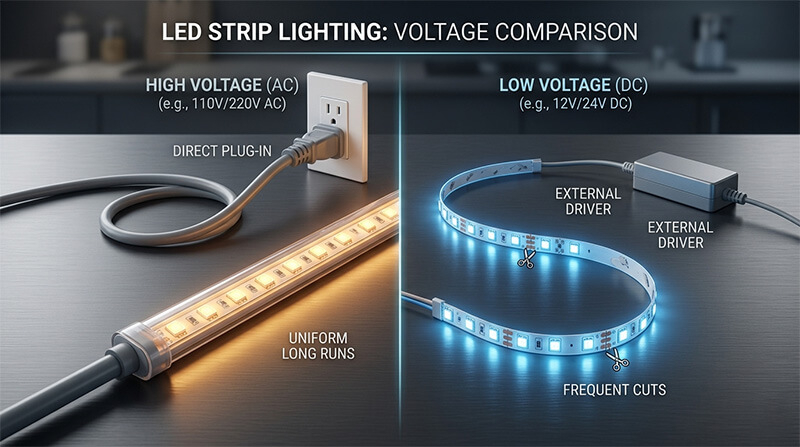
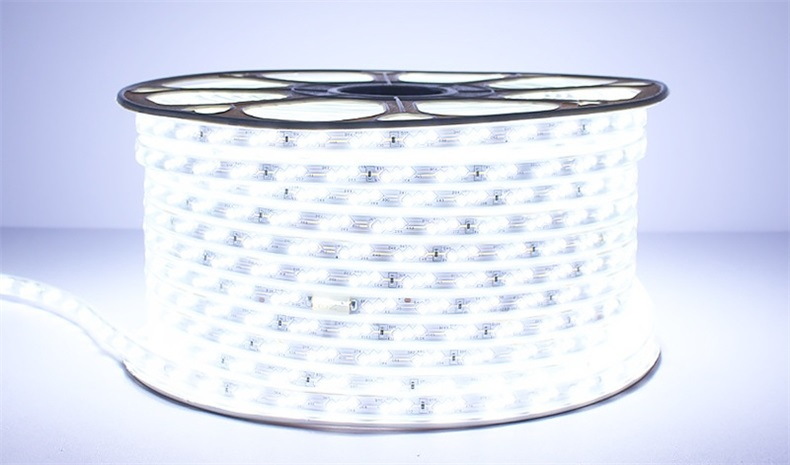
High voltage LED strips typically operate directly on AC 110V or 220V mains power. They do not require a separate low-voltage power supply (driver), as they integrate rectification inside the strip or use a plug-and-play system.
Low voltage LED strips typically operate on DC 12V or 24V, powered by an external LED driver (power supply). This is the most common type used in interior design and precision lighting.
| Category | High Voltage LED Strips (AC 110V/220V) | Low Voltage LED Strips (DC 12V/24V) |
|---|---|---|
| Power Supply | Direct connection to mains AC | Requires external DC driver |
| Safety | Higher risk, requires insulation | Safer, especially 12V systems |
| Installation | Simpler wiring, fewer components | More complex (drivers + wiring planning) |
| Max Run Length | 50–100 meters continuous | Usually 5–10 meters per power feed |
| Brightness Stability | May drop slightly over long distance | More stable and consistent |
| Flexibility | Less flexible, thicker structure | Highly flexible, easy to shape |
| Cutting Precision | Less forgiving | Easy and precise cutting |
| Control (RGB/Smart) | Limited advanced control options | Fully compatible with RGB, DMX, addressable systems |
| Maintenance | Harder to repair on-site | Easier to replace sections |
| Typical Use | Building outlines, façade lighting, outdoor long runs | Interior design, cabinets, ceilings, retail, hotels |
High voltage LED strips are designed for large-scale, long continuous lighting runs where reducing power supplies and wiring complexity is the priority.
They reduce the need for multiple drivers, making them efficient for large engineering projects.
Low voltage LED strips are the most commonly used solution in modern lighting design, especially where precision and safety matter.
They offer better control, higher visual quality, and safer installation environments.
For most modern architectural and design-driven projects, low voltage LED strips (especially 24V systems) are the preferred choice due to their stability, safety, and compatibility with advanced lighting control systems.
However, for large-scale infrastructure or building outline projects, high voltage systems remain highly efficient.
At ZBL Lighting, we manufacture and supply both high voltage and low voltage LED strip systems, including COB, SMD, RGB, and flexible neon-style solutions.
We support project designers and contractors by:
The choice between high voltage and low voltage LED strips depends on one core decision:
scale vs precision.
For professional project selection and customization, ZBL Lighting provides full-system support to ensure optimal lighting performance and installation efficiency.
Need professional help? Contact our team for expert support and personalized solutions. We’re here to assist you. Contact Us



Mobile:+86 18923408595
Email:info@zbl-lighting.com
Zip Code: 518106
Xin Wei Forth industrical Zone,Gong Ming Town,Guangming New Area,Shen Zhen,Guangdong,China