High Quality OEM/ODM LED Strip Manufacturer

High Quality OEM/ODM LED Strip Manufacturer
Published: April 13, 2026 1443
SDCM (Standard Deviation of Color Matching) is a unit used to measure how consistent the color of LED light appears. The lower the SDCM value, the more uniform the color looks to the human eye. For example, an LED strip rated ≤3 SDCM will appear visually consistent, while ≥5 SDCM may show noticeable color differences.
Now that you know the definition, let’s answer the real questions people actually have when choosing LED lighting
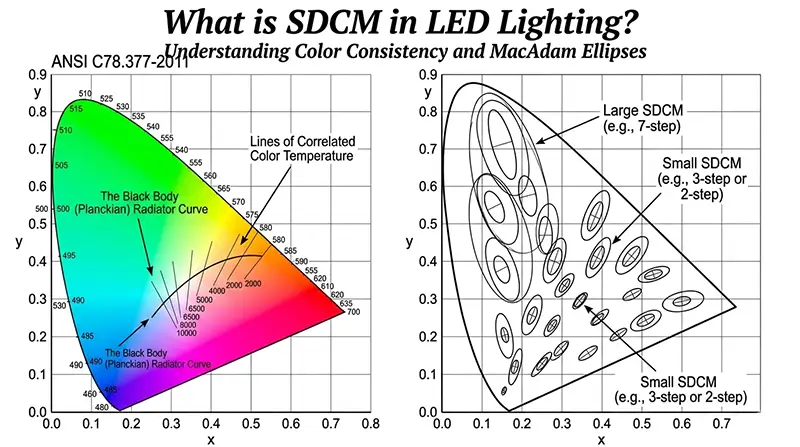
Because your eyes will notice it—especially in premium projects.
Imagine installing LED strips in a luxury hotel lobby or a high-end retail store. If one section looks slightly warmer or greener than the next, the whole space feels “off.” That’s SDCM at work.
If you’re doing architectural lighting, always aim for 3 SDCM or below.
You’ll hear this a lot—it’s just another way of saying SDCM.
A “step” refers to how far the color can deviate from the target point on a chromaticity diagram.
In simple terms:
The fewer steps, the tighter the color control.
Technically yes—but practically, it depends on your project.
Lower SDCM means:
So you don’t always need ultra-low SDCM.
Use case guide:
No. SDCM is purely about color consistency, not brightness (lumens) or efficiency (lm/W).
However, high-quality LEDs often combine:
So in premium products, they usually come together—but they are technically separate specs.
This is where many people get confused.
Think of it this way:
You need both for high-end lighting.
Through a process called binning.
LED chips are sorted into groups based on their color output. The tighter the grouping:
That’s why cheap LED strips often have inconsistent color—they use wider bins (higher SDCM).
Look for it in:
If it’s not listed, that’s usually a red flag.
Serious suppliers always specify SDCM clearly.
If you want lighting that looks clean, professional, and consistent:
Pay attention to SDCM.
It’s one of those small technical details that makes a huge visual difference—especially in projects where quality actually matters.
SDCM describes consistency between light sources; it does not replace CRI, CCT or efficacy data. Compare these separately using our CRI 80 versus CRI 90 guide and LED strip efficiency guide. For projects requiring controlled color bins, review the SMD LED strip range or request a custom production specification.
Need professional help? Contact our team for expert support and personalized solutions. We’re here to assist you. Contact Us



Mobile:+86 18923408595
Email:info@zbl-lighting.com
Zip Code: 518106
Xin Wei Forth industrical Zone,Gong Ming Town,Guangming New Area,Shen Zhen,Guangdong,China