High Quality OEM/ODM LED Strip Manufacturer

High Quality OEM/ODM LED Strip Manufacturer
Published: March 6, 2026 823
LED lighting has evolved far beyond simple on/off illumination. One of the most exciting innovations in modern lighting technology is the addressable LED strip, a type of LED strip that allows each individual LED to be controlled independently. This capability unlocks complex lighting effects, dynamic animations, and highly customized lighting environments.
Whether you are designing architectural lighting, gaming setups, commercial displays, or smart lighting installations, understanding addressable LED strips can help you choose the right solution for your project.
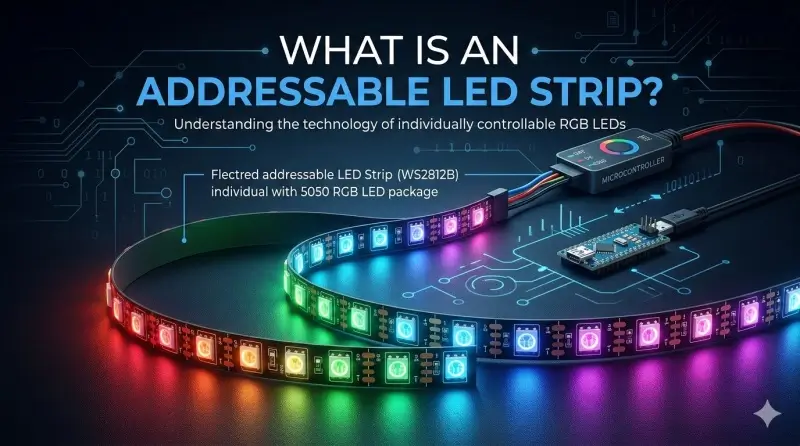
An addressable LED strip (also called a digital LED strip or pixel LED strip) is a flexible LED strip where each LED or group of LEDs has its own microchip controller. This chip allows every LED to receive instructions individually.
Unlike traditional LED strips where all LEDs show the same color at the same time, addressable strips allow effects such as:
Running light effects
Rainbow color chasing
Pixel animations
Dynamic patterns and transitions
Video or music synchronization
Each LED becomes a separate controllable pixel, which is why these strips are widely used in stage lighting, architectural lighting, gaming setups, and commercial displays.
Addressable LED strips work through a data signal sent from a controller. The controller sends digital commands down the strip, and each LED chip reads the data intended for it.
The basic system consists of:
1. LED Strip
Contains LEDs integrated with driver chips.
2. Controller
Sends data signals to control color and brightness.
3. Power Supply
Provides stable voltage to the LEDs.
4. Control Protocol
Different LED chips use different signal protocols.
A typical signal flow looks like this:
Controller → Data Signal → First LED → Second LED → Third LED → ...
Each chip reads the data assigned to it and passes the rest down the line.
Several LED driver chips are commonly used in addressable LED strips. Each has different advantages depending on the application.
One of the most popular addressable LEDs
5V operation
Built-in RGB chip + driver
Easy to program
Widely used in DIY and decorative lighting
Internal link idea:
→ See our complete guide: How WS2812 LED Strips Work
12V operation
Dual signal backup
If one LED fails, the rest of the strip keeps working
Ideal for long installations
Internal link idea:
→ WS2815 vs WS2812: Which Addressable LED Strip Is Better?
Improved version of WS2812
Available in RGBW (with dedicated white chip)
Better color mixing
For professional lighting projects, DMX512 addressable strips are widely used in:
Stage lighting
Building facades
Entertainment venues
Architectural lighting
They offer:
More stable communication
Long signal transmission
Precise control
Internal link idea:
→ SPI vs DMX512 LED Strips: Which Should You Choose?
| Feature | Regular LED Strip | Addressable LED Strip |
|---|---|---|
| Control | Entire strip same color | Each LED individually controlled |
| Effects | Static or simple dimming | Dynamic animations |
| Wiring | Simple | Requires controller |
| Applications | Basic lighting | Smart, decorative, and display lighting |
If your project only needs simple ambient lighting, a regular strip is sufficient.
But if you want dynamic visual effects, addressable LED strips are the better choice.
Because of their flexibility and programmable nature, addressable LED strips are used in many industries.
Building outlines
Bridge lighting
Tunnel safety lighting
Facade media displays
Addressable LED strips are popular in:
RGB gaming desks
PC case lighting
Streaming backgrounds
Cyberpunk-style room designs
Retail stores and exhibitions use pixel LED strips to create:
Interactive displays
Dynamic advertising panels
Brand lighting effects
Addressable LED strips integrate with smart systems for:
Music reactive lighting
Voice-controlled lighting scenes
Home automation
Before selecting an addressable strip, consider the following factors.
Common options:
5V – best for short runs and DIY projects
12V – better for longer installations
24V – used in large commercial lighting projects
Higher LED density provides smoother lighting effects.
Examples:
30 LEDs/m – basic effects
60 LEDs/m – smoother animations
144 LEDs/m – ultra-smooth pixel lighting
For outdoor projects, choose appropriate protection levels:
IP20 – indoor use
IP65 – splash resistant
IP67 – waterproof
IP68 – fully waterproof
Not all addressable LED strips are created equal. Poor-quality strips often suffer from:
Signal instability
Color inconsistency
Voltage drop
Short lifespan
For engineering or commercial installations, reliability is critical.
This is why many lighting distributors and project contractors prefer working directly with experienced manufacturers.
ZBL Lighting, for example, has over 15 years of LED strip manufacturing experience, producing addressable LED strips for lighting projects worldwide. With strict quality control, stable chip sourcing, and engineering support, manufacturers like ZBL help ensure lighting systems perform reliably in real-world installations.
Even good LED strips can fail if installed incorrectly.
Common mistakes include:
Long LED runs require power injection every few meters to prevent voltage drop.
Different LED chips require compatible controllers.
Data signal cables should be short and shielded when possible.
Installing LED strips inside aluminum profiles improves heat management and lifespan.
Addressable LED strips are rapidly evolving with:
Higher LED density COB addressable strips
Better signal stability
Smart home integrations
AI-controlled lighting scenes
As smart lighting and architectural media lighting continue to grow, addressable LED technology is becoming a key component in modern lighting design.
Addressable LED strips transform lighting from simple illumination into dynamic visual storytelling. By allowing individual control of each LED, they enable creative lighting effects that traditional LED strips simply cannot achieve.
Whether you're building a gaming room, designing architectural lighting, or creating interactive displays, choosing the right addressable LED strip will make a huge difference in both visual impact and system reliability.
Manufacturers with deep experience in LED strip production—such as ZBL Lighting, with more than 15 years of manufacturing expertise—can also provide valuable guidance when selecting the right solution for your project.
If you plan to build a high-performance lighting project, understanding addressable LED technology is the first step toward creating lighting that truly stands out.
Need professional help? Contact our team for expert support and personalized solutions. We’re here to assist you. Contact Us



Mobile:+86 18923408595
Email:info@zbl-lighting.com
Zip Code: 518106
Xin Wei Forth industrical Zone,Gong Ming Town,Guangming New Area,Shen Zhen,Guangdong,China