High Quality OEM/ODM LED Strip Manufacturer

High Quality OEM/ODM LED Strip Manufacturer
Published: January 27, 2026 Updated: January 27, 2026 1015
When selecting LED strip lights, most buyers focus on brightness (lumens), power consumption, or color temperature (Kelvin). However, one critical parameter that directly affects visual quality is often overlooked: color tolerance.
At ZBL Lighting, we see many project issues caused not by insufficient brightness, but by poor color consistency across installed LED strips. Understanding color tolerance can help you avoid these problems before they happen.
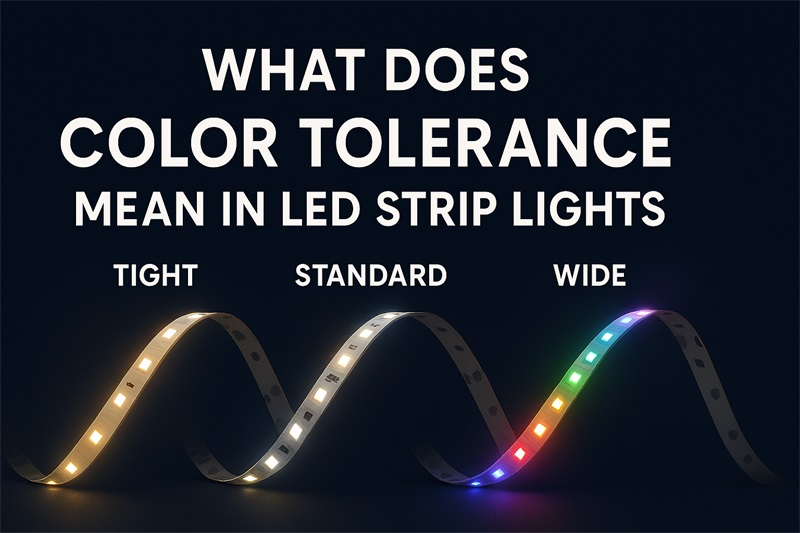
Color tolerance refers to the allowable variation in emitted light color between different LEDs that are designed to produce the same color.
In the LED lighting industry, color tolerance is usually measured in SDCM (Standard Deviation of Color Matching), also known as MacAdam steps.
Lower SDCM = higher color consistency
Higher SDCM = more visible color differences
Even if two LED strips are both labeled 3000K, they may still appear different to the human eye if their color tolerance is not well controlled.
SDCM is based on scientific studies of human visual perception.
| SDCM Value | Visual Perception |
|---|---|
| ≤ 2 SDCM | Color difference is almost imperceptible |
| 3 SDCM | Very difficult to notice |
| 4–5 SDCM | Slight color difference may be visible |
| ≥ 6 SDCM | Color difference is clearly noticeable |
For this reason, professional LED strip manufacturers, including ZBL Lighting, typically control architectural and commercial LED strips at SDCM ≤ 3.
In applications such as:
Cove lighting
Linear architectural lighting
Cabinets and shelving
Retail and office interiors
Loose color tolerance can cause:
Sections appearing warmer or cooler
Visible “color banding” along the installation
Reduced perceived quality of the space
High-quality LED strips with tight SDCM control ensure a uniform, continuous light appearance.
In real-world installations:
LED strips are often installed in long runs
Future expansion or replacement is common
If color tolerance is well controlled:
Different batches can be mixed safely
Maintenance costs are reduced
At ZBL Lighting, we apply strict LED binning and production consistency to ensure batch-to-batch color stability, which is especially important for large-scale projects.
From a designer’s or contractor’s perspective:
Consistent color = professional result
Visible color differences = low-grade product
This is why many architectural lighting specifications explicitly require:
SDCM ≤ 3
| Application | Recommended SDCM |
|---|---|
| Museums & high-end retail | ≤ 2 |
| Commercial & architectural lighting | ≤ 3 |
| Standard indoor projects | ≤ 4–5 |
| Decorative / budget lighting | ≥ 5 (not suitable for long runs) |
Color consistency depends on multiple technical factors:
LED chip binning accuracy
Phosphor and packaging quality
Manufacturing process stability (COB vs SMD)
Driving current consistency
Thermal management and heat dissipation
This explains why LED strips with similar specifications on paper can look very different once installed.
Related reading: COB vs SMD LED strips explained
Color temperature (CCT) defines what color the light is (e.g. 2700K, 3000K, 4000K).
Color tolerance (SDCM) defines how consistent that color appears across LEDs.
A precise CCT without tight SDCM control still leads to visible mismatches in lighting projects.
When choosing LED strip lights, ask not only:
“How bright is it?”
“What is the color temperature?”
But also:
What is the SDCM rating?
Is this measured on the full LED strip or only on the LED chip?
Can different production batches match in color?
At ZBL Lighting, we provide full color tolerance data for our LED strip products to help customers make informed decisions.
Color tolerance determines whether LED strip lighting looks seamless or segmented.
For architectural, commercial, and long-term installations, tight color tolerance is not a luxury—it is a requirement.
Brightness determines how strong the light is.
Color tolerance determines how good it looks.
ZBL Lighting specializes in high-efficiency, color-consistent LED strip solutions for architectural and commercial applications, with strict SDCM control and stable batch consistency.
Learn more about ZBL Lighting
Need professional help? Contact our team for expert support and personalized solutions. We’re here to assist you. Contact Us



Mobile:+86 18923408595
Email:info@zbl-lighting.com
Zip Code: 518106
Xin Wei Forth industrical Zone,Gong Ming Town,Guangming New Area,Shen Zhen,Guangdong,China