High Quality OEM/ODM LED Strip Manufacturer

High Quality OEM/ODM LED Strip Manufacturer
Published: April 22, 2026 Updated: April 22, 2026 550
For most projects, 24V LED strips are the safest and smartest choice. They offer better stability, longer run lengths, and fewer issues with voltage drop compared to 12V. If you’re working on large-scale or commercial installations, 24V is typically the standard.
That said, voltage isn’t just a number on a spec sheet—it directly affects installation, performance, and long-term reliability. Here’s how to choose the right one based on real-world use.
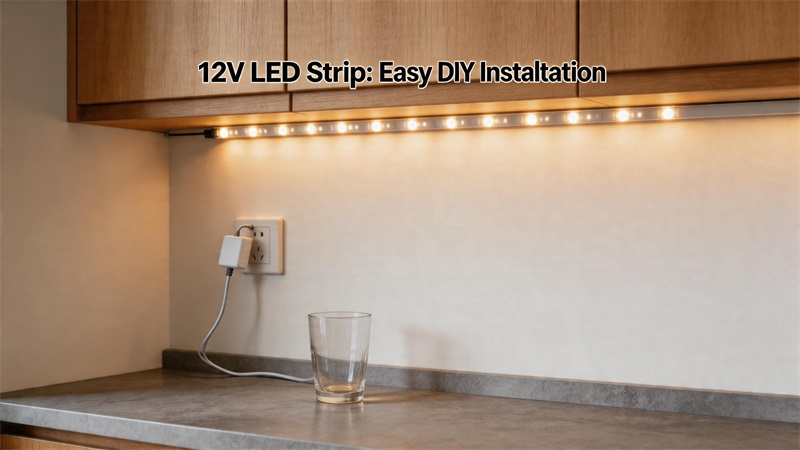
12V still has its place—mainly in small, tight installations.
Use 12V if:
Because 12V strips can be cut more frequently, they’re easier to fit into compact or custom shapes.
But push them too far, and voltage drop becomes noticeable fast.
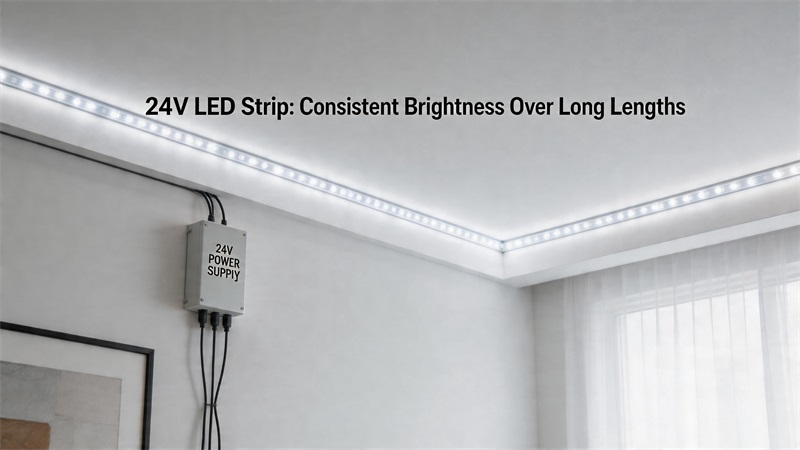
Because it solves problems before they start.
With 24V, you get:
That’s why 24V is widely used in:
If you’ve ever seen a long, perfectly even LED line—chances are it’s 24V.
5V strips are a different category—usually addressable (pixel) lighting.
They’re used for:
But they come with trade-offs:
Great for visual impact, not ideal for general lighting.
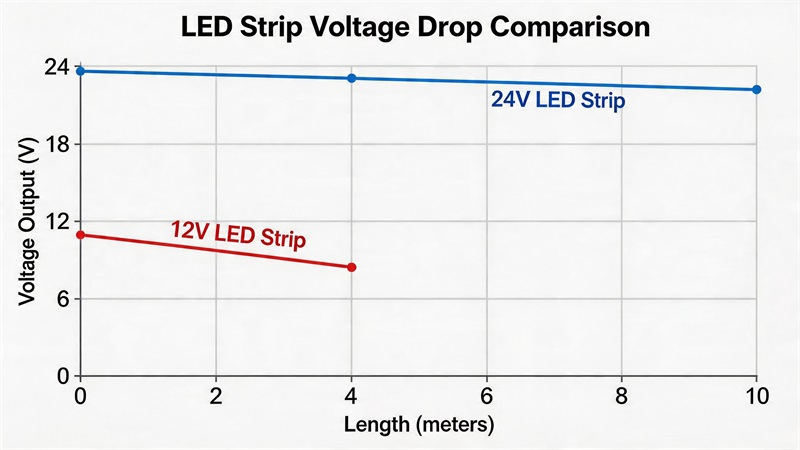
Not always—but it often helps.
Higher voltage (like 24V vs 12V):
However, extremely high voltage systems (like 110V/220V strips) introduce other considerations:
So for most professional applications, 24V hits the sweet spot.
More than most people expect.
Choosing the right voltage impacts:
If you want a cleaner, more scalable setup, 24V usually reduces headaches.
Not directly.
Brightness depends on lumens, and efficiency depends on lm/W—not voltage itself.
However, voltage indirectly affects performance:
If you haven’t already, it’s worth understanding how efficiency plays into system design:What is LED Strip Efficiency (lm/W)?
This is where voltage and quality intersect.
Even with the right voltage, poor LED binning can lead to visible color variation.
If your project requires a clean, uniform look, you should also pay attention to: What is SDCM in LED Lighting?
Because voltage keeps brightness stable—but SDCM keeps color consistent.
A quick way to decide:
If you’re unsure, default to 24V—it covers most use cases with the least risk.
Choosing the wrong voltage doesn’t just affect performance—it complicates your entire project.
Choosing the right one makes everything easier:
And in most cases, that right choice is simple: go with 24V and build from there.
Need professional help? Contact our team for expert support and personalized solutions. We’re here to assist you. Contact Us



Mobile:+86 18923408595
Email:info@zbl-lighting.com
Zip Code: 518106
Xin Wei Forth industrical Zone,Gong Ming Town,Guangming New Area,Shen Zhen,Guangdong,China