High Quality OEM/ODM LED Strip Manufacturer
High Quality OEM/ODM LED Strip Manufacturer
Published: April 17, 2026 Updated: September 24, 2026 52
Tunnel lighting is often treated as a brightness problem. In practice, continuity, orientation, fault containment and maintainability are just as important. A linear light that looks impressive in a short sample can become difficult to power and service over hundreds of metres.
Divide the tunnel into functional and electrical zones. Set illumination and guidance objectives, then design independent circuits, feed intervals, emergency behaviour, mounting protection and access for replacement. Validate glare and visual continuity with a representative on-site section.
A continuous LED line can help users understand direction and boundaries, but it may not provide adequate working illuminance by itself. Define whether the strip is used for wall washing, low-level route guidance, edge marking, general illumination or emergency wayfinding. Each role leads to different output, mounting height and backup-power requirements.
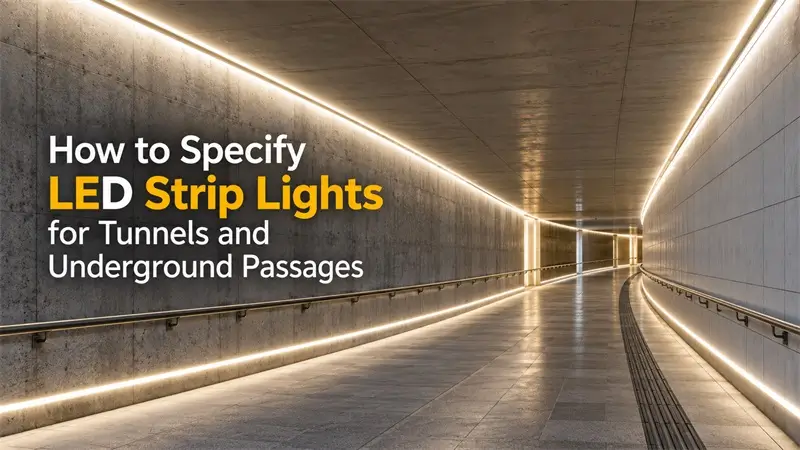
Divide the route by entrances, cross passages, equipment rooms, changes in geometry and evacuation sections. Electrical zoning should limit the distance lost after a single failure. It should also allow technicians to isolate a section without shutting down the complete route.
| Design layer | What to document |
|---|---|
| Visual | Required brightness, uniformity, glare control and guidance continuity |
| Electrical | Driver locations, circuit length, voltage drop and protection |
| Emergency | Backup source, operating duration and failure state |
| Mechanical | Profile, clips, impact protection, joints and expansion movement |
| Maintenance | Access points, replaceable section length and spare strategy |
Drivers entering a road tunnel and people moving through an underground passage experience changing brightness. An exposed high-output line at eye level may produce discomfort and reflections on wet surfaces. Diffusion, shielding, mounting angle and output zoning can be more effective than simply reducing wattage everywhere.
Use parallel branches and known feed intervals. Higher-voltage DC strips may support longer runs with lower current, but maximum powered length must come from product testing. Place drivers where heat can escape and technicians can reach them safely. Review the calculations in our long-run LED strip design guide.
An IP rating is only one line of the specification. Jacket chemistry, cable entry and joint construction often determine actual service life.
Do not describe a normal strip as emergency lighting merely because it can connect to a battery. The project must define required illumination, duration, circuit integrity, monitoring and changeover behaviour. OSHA guidance for underground construction also distinguishes basic illumination from emergency provisions.
Build a section containing the real strip, profile, connector, cable length and driver. Operate it long enough to stabilise thermally. Measure the beginning and end, inspect reflections and test a simulated circuit failure. The mock-up should answer practical questions that a datasheet cannot.
ZBL Lighting offers a 36V tunnel guidance LED strip and other long-run industrial configurations. Start with the broader tunnel-lighting solution page, then provide route drawings and circuit lengths for engineering review.
Sometimes it can support guidance or supplementary illumination, but adequacy depends on the required photometry, mounting and regulations. It should not be assumed.
There is no universal height. It depends on guidance purpose, sight lines, vehicle clearance, glare and maintenance access.
Short, documented service sections reduce closure time and prevent technicians from replacing an unnecessarily long route after local damage.
Need professional help? Contact our team for expert support and personalized solutions. We’re here to assist you. Contact Us
PROJECT & OEM ENQUIRIES
Describe the application and the result you need. Our team will review the electrical, optical and mechanical requirements before recommending a product or sample.
Fields marked * are required. Share what is available—we can help clarify the rest.



Mobile:+86 18923408595
Email:info@zbl-lighting.com
Zip Code: 518106
Xinwei Fourth Industrial Zone, Gongming Subdistrict, Guangming District, Shenzhen, Guangdong, China