High Quality OEM/ODM LED Strip Manufacturer
High Quality OEM/ODM LED Strip Manufacturer
Published: September 22, 2026 Updated: September 24, 2026 13
Choosing an LED strip for a warehouse aisle is mainly a lighting decision. Choosing one for a mine, petrochemical plant, paint area or grain-processing facility is first a safety and compliance decision—and only then a lighting decision.
The phrase “explosion-proof LED strip” is often used too loosely. A rugged waterproof strip is not automatically suitable for a hazardous location. The correct product must match the classified area, the gas or dust involved, the required protection method, the temperature limits and the rules of the destination market.
To specify hazardous-location LED strip lighting correctly, obtain the site classification before selecting the strip. Then verify that the complete lighting system—not merely the LED tape—has suitable certification and markings for that location. Check ambient temperature, maximum surface temperature, ingress protection, cable entries, drivers, connectors, mounting method and maintenance access. Final selection and installation should be approved by the project’s qualified electrical or hazardous-area professional.
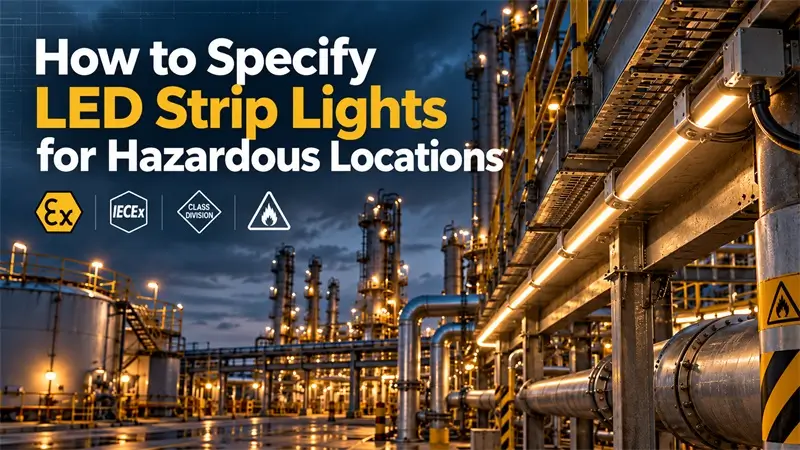
The most expensive specification error is starting with wattage, voltage or IP rating before confirming the area classification. Hazardous areas are classified according to the type of flammable material and how likely an ignitable concentration is to be present.
Two systems are commonly encountered:
| System | Typical designations | Common markets |
|---|---|---|
| Zone system | Gas: Zone 0, 1, 2; Dust: Zone 20, 21, 22 | IEC-based markets and the European Union |
| Class/Division system | Class I, II or III; Division 1 or 2; gas/dust groups | United States and parts of North America |
These systems describe risk differently and should not be converted casually. OSHA notes that each room, section or area must be considered individually, and that equipment selection and wiring methods for Zone-classified installations require appropriate professional supervision. In practical terms, the lighting supplier should receive the classification already established by the responsible engineer—not guess it from a photograph or a short application description.
If any of these items is unknown, pause product selection. “Oil and gas project” or “mining application” is not a complete area classification.
ATEX, IECEx and North American hazardous-location approvals are related to explosion protection, but they are not interchangeable labels. ATEX Directive 2014/34/EU applies to equipment and protective systems intended for use in potentially explosive atmospheres placed on the EU market. IECEx provides an international conformity-assessment framework. North American projects may specify Class/Division or Class/Zone markings and certification by an accepted testing body.
Always request documentation for the exact product configuration being quoted. A certificate held by a manufacturer, or by another product in the same catalogue, does not automatically cover every LED density, voltage, cable length, connector or driver.
One useful purchasing rule is simple: compare the project specification, product nameplate and certificate side by side. If the markings do not match, ask for clarification before approval.
An LED strip is only one part of the electrical system. The complete installation may include a strip or linear luminaire, power supply, junction box, connectors, end caps, cable glands, mounting channel and control equipment. Safety depends on the approved construction and on maintaining that construction during installation.
This matters because flexible lighting is frequently cut, joined or terminated on site. A connector that is convenient in a normal architectural project may invalidate the protection concept in a classified location. Unless the product documentation explicitly permits field cutting and supplies an approved termination method, do not assume that a certified reel can be cut and resealed like an ordinary waterproof strip.
Practical rule: treat every cut, joint, cable entry and transition to the driver as part of the hazardous-area design.
Two temperature values must be checked separately:
Lower wattage does not automatically guarantee a suitable temperature class. LED junction temperature, current, thermal path, encapsulation, mounting surface and ambient temperature all affect the final result. A strip installed inside a tight recess can run significantly hotter than the same strip mounted on an aluminium profile in free air.
Ask the supplier whether the declared rating depends on a specific profile, spacing, orientation or maximum run length. Where a project requires continuous operation, thermal verification under the actual installation conditions is more useful than a room-temperature bench test.
IP65, IP67 and IP68 describe resistance to dust and water ingress under defined test conditions. They do not establish suitability for an explosive atmosphere. An IP68 strip may survive immersion and still be completely unsuitable for a classified gas or dust area.
Use IP ratings to address the environmental exposure after the hazardous-location requirement has been satisfied. For industrial projects, also consider:
A silicone jacket that performs well outdoors may not resist every hydrocarbon or industrial chemical. Material compatibility should be confirmed against the substances present at the site.
Long industrial routes often favour 24V, 36V or 48V systems because higher voltage can reduce current for a given power level and help control voltage drop. That does not mean the highest voltage is automatically best. The decision must account for the approved product configuration, touch-voltage rules, cable size, power-injection points, driver location and fault protection.
For every proposed run, calculate:
Moving the driver outside the classified area can simplify some projects, but the cable route, protective devices and entry into the hazardous area still require proper design.
Industrial linear lighting may serve several different purposes: safe access, equipment inspection, process visibility, emergency guidance or coloured status indication. Each requires a different specification.
| Application | Useful priorities | Common mistake |
|---|---|---|
| Walkways and tunnels | Continuous visibility, controlled glare, long-run voltage stability | Choosing maximum brightness without considering glare and spacing |
| Machine inspection | High CRI, appropriate CCT, flicker control | Using decorative-grade colour quality |
| Safety guidance | Uniform line, visibility through dust or smoke, backup-power strategy | Treating normal lighting as an emergency system |
| Status signalling | Clearly defined colours, control logic, fail-safe behaviour | Using colour-changing effects without a control-risk assessment |
Photometric design is still necessary. A strip with high lumens per metre can perform poorly if it creates glare, is hidden by equipment or is installed where dust quickly reduces output.
Industrial LED strip failures often occur at interfaces rather than in the LEDs themselves. Cable entries, end terminations, unsupported bends and poorly located power supplies deserve the same attention as the strip specification.
For underground routes, review our practical pages on mine lighting and tunnel lighting. These applications also require careful attention to cable routing, continuous operation and maintainability.
A clear request for quotation saves time and prevents technically unsuitable substitutions. Include the following:
ZBL Lighting uses this information to narrow the suitable configuration before discussing cosmetic options. Our industrial LED strip light range includes long-run and certified hazardous-area solutions, while project-specific lengths, cables and electrical configurations can be evaluated through our custom LED strip service. Certification coverage should always be confirmed against the exact model and destination market at quotation stage.
No. An IP rating only describes protection against ingress of solids and water. Hazardous-location suitability requires the correct protection concept, certification and markings for the classified area.
Only when the product documentation and certificate permit it and the approved termination procedure is followed. Many systems should be ordered as factory-terminated lengths.
No. ATEX is an EU legal framework for equipment intended for potentially explosive atmospheres. IECEx is an international conformity-assessment system. A project may request one or both, depending on the market and specification.
They describe broadly similar lower-frequency gas hazards, but they are not automatically interchangeable. Marking, permitted protection techniques and local code requirements still need to be checked.
Send the area classification, gas or dust group, temperature requirement, ambient range, destination market and required certification before asking for wattage or price.
A hazardous-location lighting specification should be traceable: site classification leads to required equipment marking; the marking leads to an exact certified model; and the model leads to approved installation instructions. If any link in that chain is missing, resolve it before purchase.
This guide supports early product evaluation and does not replace an area-classification study, local electrical code or approval by the responsible qualified professional.
Need professional help? Contact our team for expert support and personalized solutions. We’re here to assist you. Contact Us
PROJECT & OEM ENQUIRIES
Describe the application and the result you need. Our team will review the electrical, optical and mechanical requirements before recommending a product or sample.
Fields marked * are required. Share what is available—we can help clarify the rest.



Mobile:+86 18923408595
Email:info@zbl-lighting.com
Zip Code: 518106
Xinwei Fourth Industrial Zone, Gongming Subdistrict, Guangming District, Shenzhen, Guangdong, China