High Quality OEM/ODM LED Strip Manufacturer
High Quality OEM/ODM LED Strip Manufacturer
Published: January 23, 2026 Updated: January 23, 2026 2488
In stage lighting, architectural lighting, and landscape illumination projects, DMX512 is one of the most widely used control protocols. Yet one question is repeatedly asked at the beginning of almost every project:
How many devices can a single DMX512 signal line actually control?
The answer is not a fixed number. It depends on channel capacity, fixture type, and system design. Understanding this clearly can prevent serious problems during installation and commissioning.
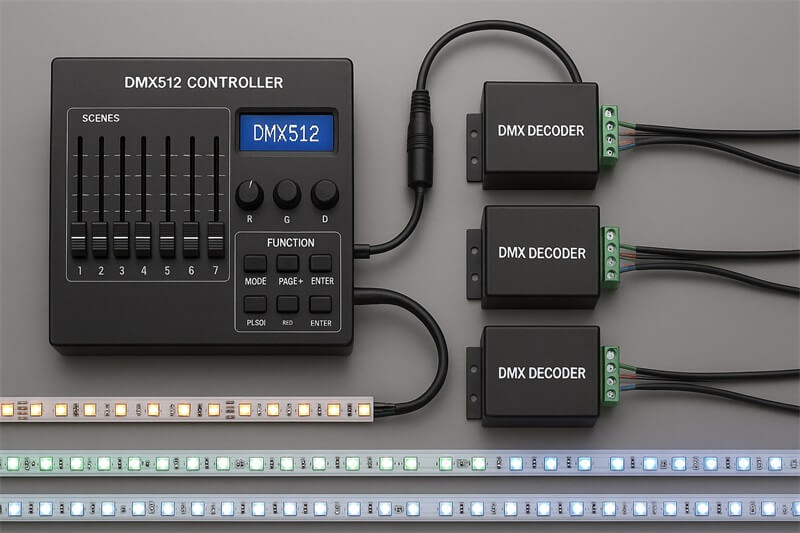
DMX512 does not mean 512 fixtures.
It means:
One DMX universe provides a maximum of 512 control channels.
Each channel carries a value from 0 to 255, used to control brightness, color, speed, movement, or other parameters.
The core rule is simple:
Number of devices = 512 ÷ channels used per device
Different lighting fixtures require very different numbers of channels.
Brightness only
Up to 512 fixtures per DMX line
Red / Green / Blue
Up to 170 fixtures (512 ÷ 3)
Red / Green / Blue / White
Up to 128 fixtures
1 pixel = 3 channels (RGB)
Approximately 170 pixels per DMX universe
⚠️ Important: This limit is based on pixels, not strip length in meters.
In real-world engineering applications, professionals almost never use all 512 channels. There are good reasons for this.
DMX512 is a serial communication protocol. As the number of devices increases, signal attenuation and interference risks also increase.
Recommended maximum length per DMX line: 300 meters
Longer distances require DMX splitters or repeaters
When all channels are fully occupied, troubleshooting becomes time-consuming and costly.
Most professional projects use only 60–80% of a DMX universe’s capacity.
Apart from channel count, DMX512 also has a hardware limitation:
A single DMX line should not directly connect more than 32 devices.
This is due to the RS485 electrical standard used by DMX512. Each device adds electrical load to the signal.
Use DMX splitters
One input, multiple isolated outputs This approach is standard practice in large-scale projects.
Experienced lighting designers typically follow these principles:
Divide the project into multiple DMX universes
Facade lighting
Landscape lighting
Linear and decorative lighting
Reserve spare channels
Avoid using all 512 channels
Allow room for future expansion
Standardize fixture parameters
Same channel modes
Clear addressing plan
In practice, many DMX problems do not come from the controller, but from the fixtures themselves, such as:
Inconsistent channel definitions
Unstable DMX timing
Flickering or data loss over long daisy chains
This is why professional projects prioritize engineering-grade lighting products, not consumer-level fixtures.
At ZBL Lighting, we focus on DMX and pixel lighting designed specifically for long-term, professional use, including:
Stable DMX signal compatibility
Clear and consistent channel definitions
Support for large-scale DMX addressing and system planning
Customizable DMX modes for pixel LED strips and architectural lighting
Our goal is not only to make lights that turn on, but to ensure they operate reliably in complex, real-world projects.
One DMX512 signal line provides 512 channels, not 512 devices.
Successful DMX projects depend on:
Understanding channel usage
Managing signal distribution and distance
Choosing fixtures designed for professional DMX systems
Getting these fundamentals right early will save time, cost, and frustration later.
If you are planning a DMX lighting or pixel LED project and need technical guidance or product recommendations, further discussion is always welcome.
Need professional help? Contact our team for expert support and personalized solutions. We’re here to assist you. Contact Us



Mobile:+86 18923408595
Email:info@zbl-lighting.com
Zip Code: 518106
Xin Wei Forth industrical Zone,Gong Ming Town,Guangming New Area,Shen Zhen,Guangdong,China