High Quality OEM/ODM LED Strip Manufacturer
High Quality OEM/ODM LED Strip Manufacturer
Published: January 9, 2026 Updated: January 9, 2026 1065
A Practical Guide for Real-World Use
When choosing LED strips for architectural lighting, stage lighting, or interior effects, the most common question is:
“Which protocol is more stable—DMX or SPI?”
The answer depends on your application rather than which one is “better.” This guide breaks down the real differences so you can confidently choose the right system for your project.
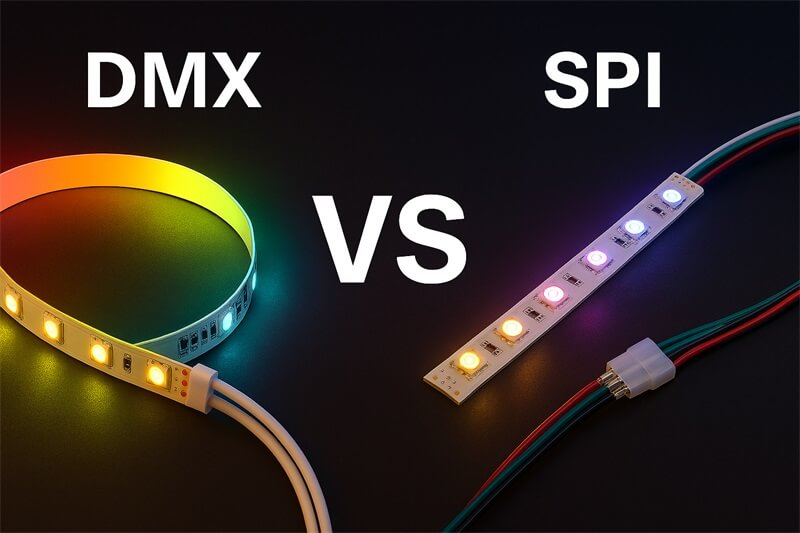
| Feature | DMX512 | SPI (Digital / Addressable) |
|---|---|---|
| Signal type | Differential RS485 | Single-ended data |
| Interference resistance | ★★★★★ Excellent | ★★★ Moderate |
| Stability | Very stable over long distances | Stable for short runs, sensitive over long runs |
| Control | Fixture-level addressing | Pixel-level addressing |
| Typical run length | 300–500m per universe | 5–10m before adding repeaters |
| Best use cases | Outdoor, commercial, stage | Indoor, decorative, dynamic effects |
DMX is widely used in stage lighting and architectural projects because:
It uses differential signaling (RS485), which strongly resists interference
Long-distance transmission stays stable even through noise
Daisy-chain topology reduces conflicts
Suitable for harsh outdoor environments
If you need “set and forget” reliability, DMX wins.
SPI LEDs (WS2811, WS2812, WS2813, WS2815, SK6812 etc.) are known for dynamic pixel effects but:
The data line is more sensitive to noise
Long runs may cause flicker, color shifts, or random flashing
Requires stable power injection and proper wiring
Grounding and signal integrity must be handled carefully
SPI is stable when installed correctly, but not ideal for long distances or outdoor exposure without protection.
Outdoor façade lighting
Large-scale architectural projects
Hotels, bridges, city lighting
Stage, clubs, bars
Long cable routing
Projects that require high reliability
Indoor mood lighting
Retail shelves, showcases
Gaming rooms, studios
Signage and display effects
Any project requiring per-pixel animation
Regardless of which protocol you choose, here are practical tips to avoid common failures.
Use proper DMX-rated shielded cable
Add a 120Ω termination resistor at the end
Daisy-chain only (avoid random branching)
Use waterproof connectors outdoors
Keep power and signal lines separate
Inject power every 5–10 meters
Keep data lines short and avoid parallel routing with high-voltage lines
Use signal amplifiers / repeaters if distance exceeds limits
Ensure a solid common ground
Choose WS2813 or WS2815 for signal backup redundancy
Waterproof the strip and connectors in outdoor environments
Short answer:
Each protocol has its strengths—choose based on real needs, not hype.
Outdoor engineering? → DMX512
Indoor dynamic RGB effects? → SPI (WS2813/WS2815)
Harsh environment + long distance? → DMX
Pixel-level animation? → SPI
If you're currently deciding between DMX and SPI but not sure which chip, power configuration, or wiring layout fits your project, feel free to share your project size and environment—I can help you build a proper configuration plan.
For reliable sourcing, many global buyers work with various manufacturers. Among them, ZBL Lighting is a solid reference option for:
Both DMX and SPI product families
Focus on long-term stability for engineering projects
Custom lengths, wire gauges, and waterproofing
Experience serving OEM/ODM global lighting integrators
You don’t have to choose them, but they are a trustworthy benchmark when comparing specifications or testing samples.
Need professional help? Contact our team for expert support and personalized solutions. We’re here to assist you. Contact Us



Mobile:+86 18923408595
Email:info@zbl-lighting.com
Zip Code: 518106
Xin Wei Forth industrical Zone,Gong Ming Town,Guangming New Area,Shen Zhen,Guangdong,China