Introduction: The Hidden Risks Behind LED Strip Popularity
LED strips have revolutionized architectural and decorative lighting due to their flexibility and energy efficiency. However, safety concerns persist: 32% of low-quality LED strips failed flame-retardancy tests in 2024, according to China's National Quality Inspection Report12. This article examines the flame-retardant properties of common LED strip materials, certification systems, and practical selection strategies to mitigate fire hazards.
1. Flame Retardancy of Key LED Strip Materials
1.1 PVC (Polyvinyl Chloride)
- Market Share: Over 60% due to low cost and flexibility.
- Flame Performance:
- Raw PVC has an oxygen index of 17-24 (UL94 HB grade, flammable).
- With flame retardants, it reaches UL94 V-2 (self-extinguishes ≤30 seconds).
- Risk: Cheap products often under-dose retardants to cut costs.
1.2 Silicone
- Advantages: Temperature resistance (-50°C–200°C), low smoke emission.
- Flame Retardancy:
- Natural oxygen index ≥28 (UL94 V-0 grade, extinguishes instantly).
- Produces non-toxic white smoke without molten drips.
- Applications: Museums, wooden structures.
1.3 Glass Fiber-Reinforced Epoxy Resin
- Features: High mechanical strength, chemical resistance.
- Fire Mechanism:
- UL94 V-0 certified (burning time <10 seconds).
- Forms a carbonized layer under heat to block oxygen.
- Usage: Industrial equipment, high-temperature environments12.
2. Certification Systems for Flame Retardancy
2.1 International Standards
- UL94 (USA): Classifies materials as HB/V-2/V-1/V-0, with V-0 being the highest.
- IEC 60695: Specifies vertical flame test methods.
2.2 Chinese Standards
- GB/T 2408-2021: Aligns with UL94 ratings for plastic flammability.
- GB 7000.1: Mandatory 3C certification including flame tests.
3. How to Verify Flame Retardancy: A 4-Step Checklist
- Check Certifications
- Look for UL/GB marks and validate codes via .
- Material Inspection
- High-quality PVC shows evenly distributed retardant particles under magnification.
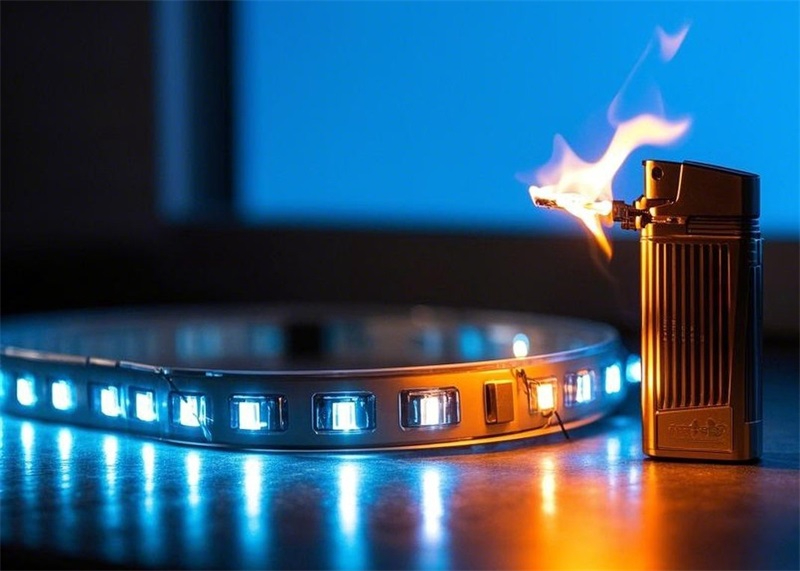
- Simple Burn Test
- Ignite a 5cm sample:
- V-0: Self-extinguishes in ≤2 seconds.
- Non-compliant: Continues burning with pungent fumes.
- Request Lab Reports
- Demand CNAS/CMA-accredited test reports (e.g., oxygen index ≥28 for silicone).
4. Safety Guidelines for LED Strip Installation
- Power Management
- Operate at ≤80% of rated power (e.g., 11.5W/m for a 14.4W/m strip)12.
- Heat Dissipation
- Maintain ≥3cm clearance from surfaces per JGJ 16-200812.
- Environmental Suitability
- Use silicone strips (150°C-resistant) in kitchens; IP65-rated strips in damp areas.
- Circuit Protection
- Install 10A overload protectors to prevent short circuits.
- Maintenance
- Check insulation every 6 months (resistance >2MΩ).
5. Emerging Flame-Retardant Technologies (2025 Trends)
- Nanocomposites
- Graphene/magnesium hydroxide blends boost oxygen indices to 35+.
- Bio-Based Retardants
- Cardanol derivatives from cashew shells achieve V-0 without toxicity.
- Smart Coatings
- Thermal-responsive layers expand at 130°C to create fire barriers12.
Conclusion: Prioritize Safety in LED Strip Selection
Electrical fires caused 28.7% of total fires in 2024, with substandard lighting being a major contributor12. Always opt for UL94 V-0 or GB/T 2408-compliant strips and request third-party test reports. By combining certified materials, proper installation, and regular maintenance, users can significantly reduce fire risks while enjoying innovative lighting solutions.