High Quality OEM/ODM LED Strip Manufacturer
High Quality OEM/ODM LED Strip Manufacturer
Published: May 7, 2026 Updated: September 24, 2026 10
“Waterproof” is not a complete LED strip specification. IP65, IP67 and IP68 describe different levels of enclosure protection, but they do not promise unlimited outdoor life, chemical resistance or a waterproof installation after cutting.
Use IP65 for water jets or splash exposure where immersion is not expected; IP67 for temporary immersion under the stated test conditions; and IP68 only after confirming the manufacturer’s specified depth and duration. Always evaluate connectors, cut ends, cable entries, drainage, UV and chemical exposure separately.
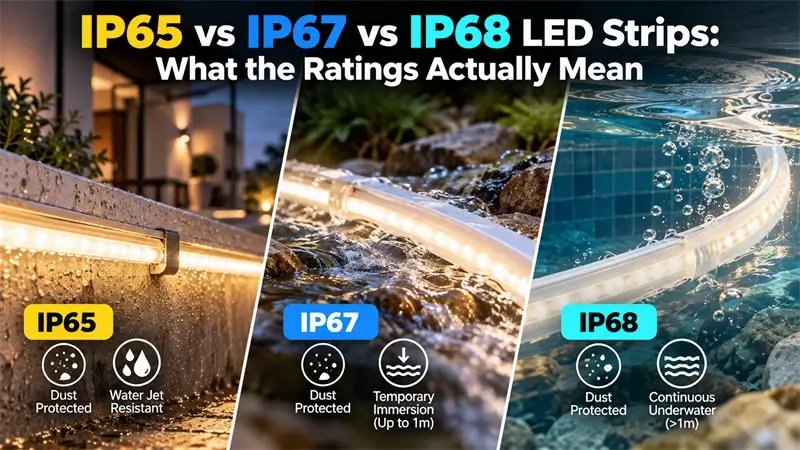
IEC 60529 defines degrees of protection provided by enclosures. The first digit concerns access to hazardous parts and ingress of solid objects; the second concerns water. For IP6X, the enclosure is dust-tight. The final digit distinguishes the water test.
| Rating | Water protection in practical terms | Typical use |
|---|---|---|
| IP65 | Protected against water jets | Sheltered exterior details, damp interiors, splash zones |
| IP67 | Protected against temporary immersion under specified conditions | Exposed architectural details, wet cleaning, possible short flooding |
| IP68 | Protected for immersion under conditions agreed by manufacturer and user | Applications requiring a declared depth and duration |
A thicker or fully encapsulated construction can affect size, flexibility, heat transfer, optical appearance, cut length and installation method. If the project only needs splash protection, an IP68 construction may add cost and complexity without solving a real risk.
More importantly, IP68 conditions are not universal. Ask for the tested depth, duration, water type and whether the rating applies to a factory-sealed complete length.
Water often enters at cut ends, cable exits, connectors or field-made joints. A factory extrusion can be excellent while an improvised end cap fails within weeks. Specify:
UV radiation can yellow or embrittle unsuitable polymers. Standing water and freeze-thaw cycles stress seals. Chlorine, salt, oil and cleaning chemicals may attack the jacket. Heat trapped in a sealed profile accelerates LED and material ageing. State these exposures in the RFQ instead of writing only “outdoor IP68.”
An IP68 strip is not automatically approved for swimming pools, hazardous locations or food-processing equipment. Those uses involve electrical, material and certification requirements beyond IEC 60529. Read our hazardous-location guide when explosive gas or dust may be present.
ZBL Lighting supplies silicone neon flex and industrial LED strip configurations for different environments. We recommend defining exposure and installation details before choosing the highest number on a datasheet.
No. IP67 addresses temporary immersion under defined conditions. Permanent immersion requires a suitable IP68 product with declared conditions and a compliant installation.
It can. The cut end must be terminated using the manufacturer’s approved method; some certified or moulded products should not be field-cut.
Silicone generally performs well outdoors, but formulation and testing still matter. Request material and project-specific evidence.
Need professional help? Contact our team for expert support and personalized solutions. We’re here to assist you. Contact Us
PROJECT & OEM ENQUIRIES
Describe the application and the result you need. Our team will review the electrical, optical and mechanical requirements before recommending a product or sample.
Fields marked * are required. Share what is available—we can help clarify the rest.



Mobile:+86 18923408595
Email:info@zbl-lighting.com
Zip Code: 518106
Xinwei Fourth Industrial Zone, Gongming Subdistrict, Guangming District, Shenzhen, Guangdong, China