High Quality OEM/ODM LED Strip Manufacturer

High Quality OEM/ODM LED Strip Manufacturer
Published: March 10, 2026 340
LED strip lights may look simple at first glance. A flexible circuit board, a row of LEDs, and a power supply—that’s all it takes to create ambient lighting in homes, retail spaces, or architectural designs.
However, anyone who has used different LED strips over time will notice something interesting: not all of them age the same way.
Some begin to lose brightness after only a few months. Others develop dark sections along the strip, inconsistent color, or visible flickering. Meanwhile, certain LED strips continue running smoothly for years without noticeable degradation.
After working with lighting projects long enough, many buyers discover a common pattern: factory-direct LED strip lights tend to last significantly longer than many generic products sold through online marketplaces.
This difference isn’t just about branding or price—it comes down to how the product is actually manufactured.
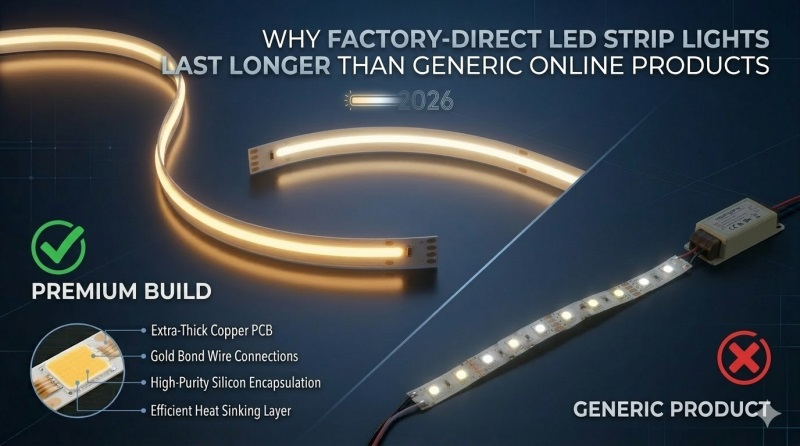
When people shop for LED strip lights, they usually compare brightness, wattage, or LED density. But one of the most important components is something most buyers never see—the PCB (printed circuit board) that carries the LEDs.
LEDs generate heat during operation. If the board cannot dissipate that heat effectively, temperatures gradually build up along the strip. Over time, this accelerates LED degradation and shortens the lifespan of the entire system.
One of the most noticeable differences between entry-level products and factory-direct strips lies in copper thickness and heat management.
| Feature | Typical Online Marketplace Products | Factory-Direct LED Strips |
|---|---|---|
| PCB copper thickness | Often 1oz | Often 2oz or higher |
| Heat dissipation | Basic | Optimized for long-term stability |
| Long-term brightness stability | Moderate | Significantly improved |
For commercial lighting applications—such as retail environments, gyms, or architectural lighting—this difference becomes especially important. Lower operating temperatures directly translate into longer service life.
If you're planning larger lighting installations, you may also want to explore our guide on LED strip heat dissipation design (internal link placeholder), which explains how thermal management affects LED longevity.
Two LED strips may look identical on paper. They might use the same LED type, similar wattage, and even similar brightness ratings.
But the manufacturing process behind them can be completely different.
One critical stage in LED strip production is reflow soldering, where the LEDs are mounted onto the PCB. If temperature curves are poorly controlled, solder joints may weaken over time. This can eventually lead to intermittent failures or sections of LEDs going dark.
Professional manufacturing environments carefully monitor factors such as:
SMT placement accuracy
Reflow temperature curves
LED binning and color consistency
Full-length aging tests
These processes require time, equipment, and strict quality control. As a result, they are far more common in dedicated manufacturing facilities than in mass-distributed low-cost supply chains.
With 15 years of LED strip manufacturing experience, ZBL Lighting has built its production process around these reliability standards, which is why many commercial lighting integrators prefer working directly with experienced manufacturers.
LED technology is highly efficient, but it is still sensitive to heat. Excessive operating temperatures accelerate lumen depreciation and reduce the effective lifespan of LEDs.
That’s why experienced lighting engineers rarely focus on brightness alone. Instead, they balance multiple factors:
Power density per meter
Installation environment
Aluminum profile or channel usage
Power supply compatibility
For example, in hospitality environments or showroom lighting projects, LED strips are often installed inside aluminum channels. These channels serve both aesthetic and thermal purposes, helping disperse heat and stabilize performance.
In our article How to Choose the Right LED Strip for Commercial Lighting (internal link placeholder), we explain how different power levels influence durability in real-world applications.
For simple decorative lighting at home, buying LED strips online can be perfectly adequate. But once lighting becomes part of a commercial project, the priorities change.
Businesses typically focus on three key concerns:
Consistent product batches
Long-term reliability
Technical support and customization
When a project involves hundreds or thousands of meters of LED strips, color consistency becomes essential. Even small variations in color temperature between batches can be noticeable once installed.
This is why many contractors prefer direct relationships with manufacturers rather than relying solely on marketplace sellers.
| Purchasing Channel | Typical Use Case | Main Advantage |
|---|---|---|
| Online marketplaces | DIY or short-term decoration | Fast and convenient |
| Factory-direct sourcing | Commercial or architectural projects | Higher stability and consistency |
Manufacturers such as ZBL Lighting often provide additional support including custom specifications, stable batch production, and long-term supply—services that are difficult to achieve through anonymous distribution channels.
If you're evaluating suppliers, our LED Strip Supplier Selection Guide (internal link placeholder) can help identify what separates reliable manufacturers from simple resellers.
Not every company claiming to be a “factory” actually operates a full production facility. Some are trading companies or small assembly operations.
Before choosing a supplier, it helps to look at a few indicators:
Do they operate their own SMT production lines?
Can they provide real testing reports?
Do they have long-term engineering clients?
Can they maintain stable product batches over time?
Established manufacturers usually prioritize product stability and long-term partnerships rather than competing purely on price.
LED strip lights may appear simple, but their durability depends on a combination of design, materials, and manufacturing control. From PCB copper thickness to soldering precision and thermal management, every stage of production affects long-term performance.
For small decorative applications, inexpensive products may work well enough. But for commercial spaces or architectural lighting projects, reliability quickly becomes more valuable than short-term savings.
With over 15 years of manufacturing experience, ZBL Lighting focuses on producing high-quality LED strip solutions designed for consistent performance in demanding lighting environments.
When choosing LED strip lighting for your next project, it’s worth asking a simple question:
Is this strip designed just to light up today—or to keep performing reliably for years?
Need professional help? Contact our team for expert support and personalized solutions. We’re here to assist you. Contact Us



Mobile:+86 18923408595
Email:info@zbl-lighting.com
Zip Code: 518106
Xin Wei Forth industrical Zone,Gong Ming Town,Guangming New Area,Shen Zhen,Guangdong,China