High Quality OEM/ODM LED Strip Manufacturer

High Quality OEM/ODM LED Strip Manufacturer
Published: May 26, 2026 Updated: May 26, 2026 731
If you cut an LED strip in the wrong place (not on the designated cut marks), you usually break the internal circuit, which means that section and often everything beyond it will stop working. In standard SMD strips, this disrupts the power flow and the LEDs won’t light up properly. In RGB or addressable strips, it can also interrupt the signal chain, causing flickering, wrong colors, or complete failure of the remaining strip. In most cases, it cannot be easily repaired and the damaged section or the whole strip must be replaced.
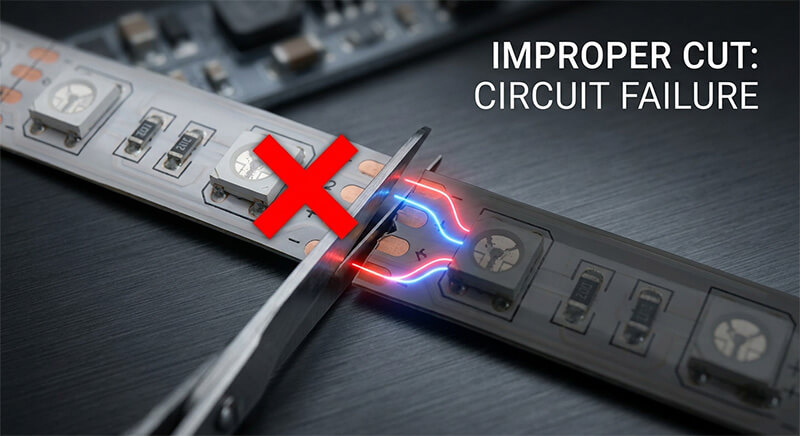
Before diving into the consequences of cutting LED strips in the wrong place, it’s essential to understand how these lights are structured. LED strips are made up of a series of small LED chips mounted on a flexible circuit board, powered by an electrical current. To maintain functionality and continuity, these strips have designated “cut lines” marked at regular intervals. These cut lines are specifically designed points where the strip can be safely separated without disrupting the electrical circuit.
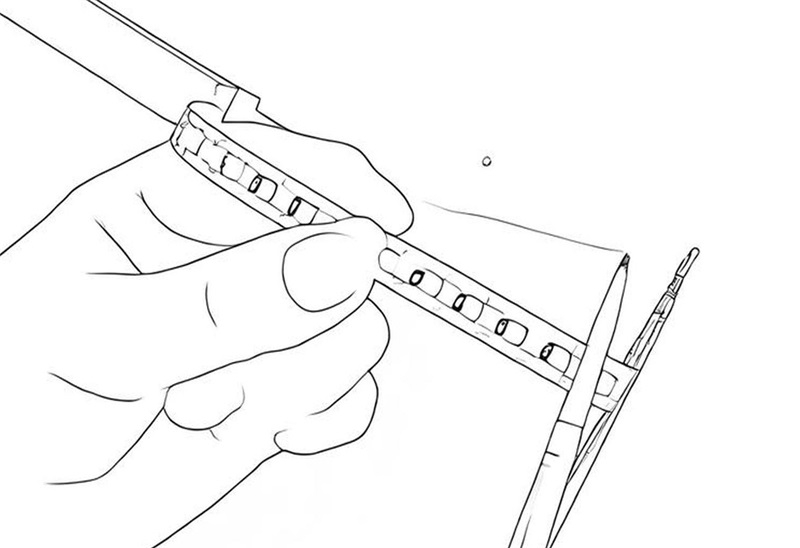
The cut lines on an LED strip light correspond to the end of one circuit and the beginning of another. When you cut along these marked lines, you’re cutting between the circuits, which keeps each section functional. Cutting outside of these designated points can break the circuit, leading to several issues, including partial or complete light failure, electrical hazards, and difficulty in reconnecting the strips.
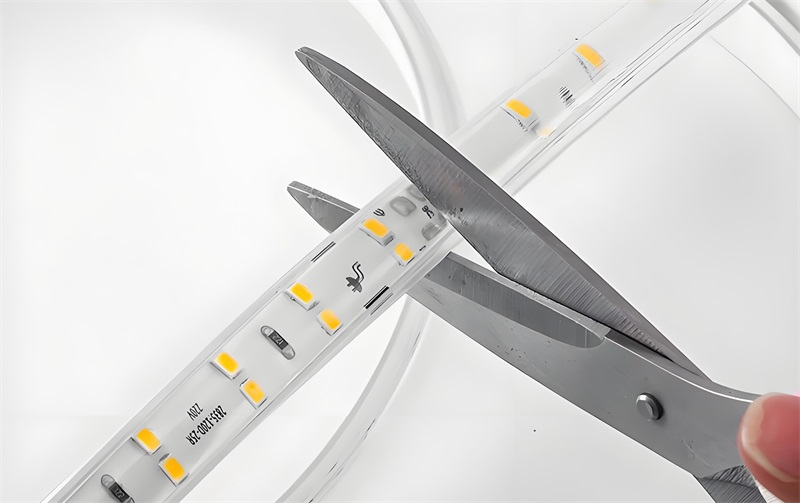
Malfunctioning Sections If you cut LED lights outside of the marked cut lines, you risk severing the electrical circuit. This means the section you’ve cut off may not light up, and in some cases, even the remaining strip may stop working. Without a complete circuit, electricity cannot flow through the strip, leaving you with one or more malfunctioning segments.
Irreversible Damage Unfortunately, cutting LED strips in the wrong place often results in permanent damage. LED strips have conductive copper points at each cut line that allow for safe separation and reconnection. If you cut between these copper points, reconnecting the strip may be impossible. In such cases, you may need to replace the damaged section entirely, which can be costly and inconvenient.
Increased Safety Risks Cutting outside the cut lines can expose live electrical parts and compromise the insulation that protects the strip. This can increase the risk of short circuits or electrical fires. If you’re installing LED strips in moisture-prone areas or near other electronic devices, an exposed circuit could be dangerous.
Aesthetic Issues Incorrect cuts can also affect the appearance of your LED lighting installation. If sections of the LED strip aren’t lighting up as intended, it can lead to uneven illumination, dark spots, or gaps in lighting. This can diminish the visual appeal of your setup, especially if you’re using LED lights for decorative purposes.
Difficulty in Repairing or Reconnecting Even if you attempt to re-solder or reconnect incorrectly cut strips, the process can be challenging and may not guarantee a secure connection. Re-soldering can be tricky, as the strips are often thin and delicate. Moreover, without the copper cut points, reconnecting the strip may require specific tools or additional connectors, which can be difficult for most users to handle.
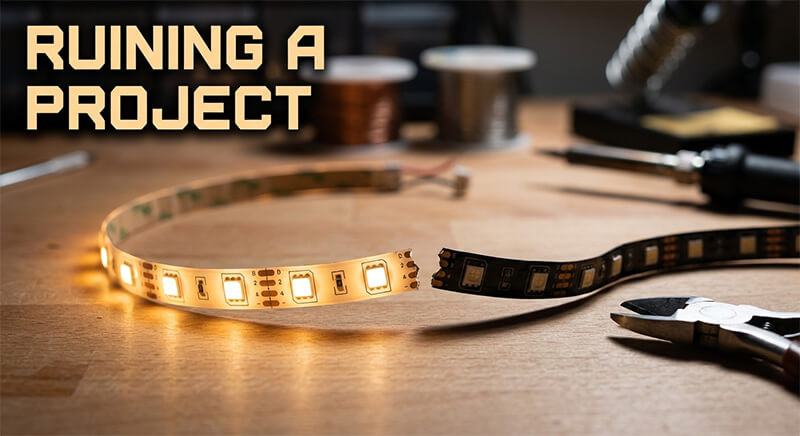
If you find yourself in a situation where you’ve cut your LED strip lights in the wrong place, there are a few potential solutions to salvage the lights.
Use LED Strip Connectors LED strip connectors are designed to join two pieces of an LED strip without the need for soldering. Depending on where the cut was made, you may be able to use a connector to restore continuity between sections. Be sure to purchase connectors that are compatible with the width and type of LED strip you’re using.
Re-soldering the Strip For those with soldering experience, re-soldering the cut LED strip is another potential solution. Carefully solder a wire to each side of the cut to bridge the gap. Be mindful, though, that this process requires precision, as excessive heat can damage the LED components. This approach may also affect the flexibility of the strip, so it’s best for permanent installations.
Replace the Damaged Section In some cases, it may be best to simply replace the affected section of the LED strip. This is particularly recommended if the cut has caused significant damage that cannot be repaired or if safety is a concern. Measure the length needed, cut it at the correct point, and connect it to the existing strip using a compatible connector.
To avoid issues when cutting LED lights, follow these best practices:
Cutting LED lights in the wrong place can lead to various issues, from malfunctioning lights to potential safety risks. By understanding the structure of LED strips, identifying the designated cut lines, and using proper cutting tools, you can avoid these common mistakes. If an incorrect cut has already been made, solutions like using connectors or re-soldering may help restore functionality. Taking extra care while handling LED strips ensures a smooth, safe, and visually pleasing lighting experience.
By following these guidelines, you’ll be able to install and enjoy your LED lights confidently without facing unnecessary complications.
Need professional help? Contact our team for expert support and personalized solutions. We’re here to assist you. Contact Us
PROJECT & OEM ENQUIRIES
Describe the application and the result you need. Our team will review the electrical, optical and mechanical requirements before recommending a product or sample.
Fields marked * are required. Share what is available—we can help clarify the rest.



Mobile:+86 18923408595
Email:info@zbl-lighting.com
Zip Code: 518106
Xinwei Fourth Industrial Zone, Gongming Subdistrict, Guangming District, Shenzhen, Guangdong, China