High Quality OEM/ODM LED Strip Manufacturer

High Quality OEM/ODM LED Strip Manufacturer
July 20, 2026 12
RGB and RGBIC LED strips are both popular choices for colorful lighting, but they are designed for different lighting effects and control requirements.
The simplest difference is this:
A standard RGB LED strip usually displays one color across the same controlled section, while an RGBIC LED strip can control different sections independently, allowing multiple colors and dynamic effects to appear at the same time.
For a simple color-changing project, RGB may be all you need. If you want chasing, running, rainbow, gradient, or pixel-style effects, RGBIC is generally the better choice.
However, the difference involves more than just the lighting effect. The LED type, control IC, voltage, controller, power distribution, installation environment, and project requirements should all be considered before choosing between them.
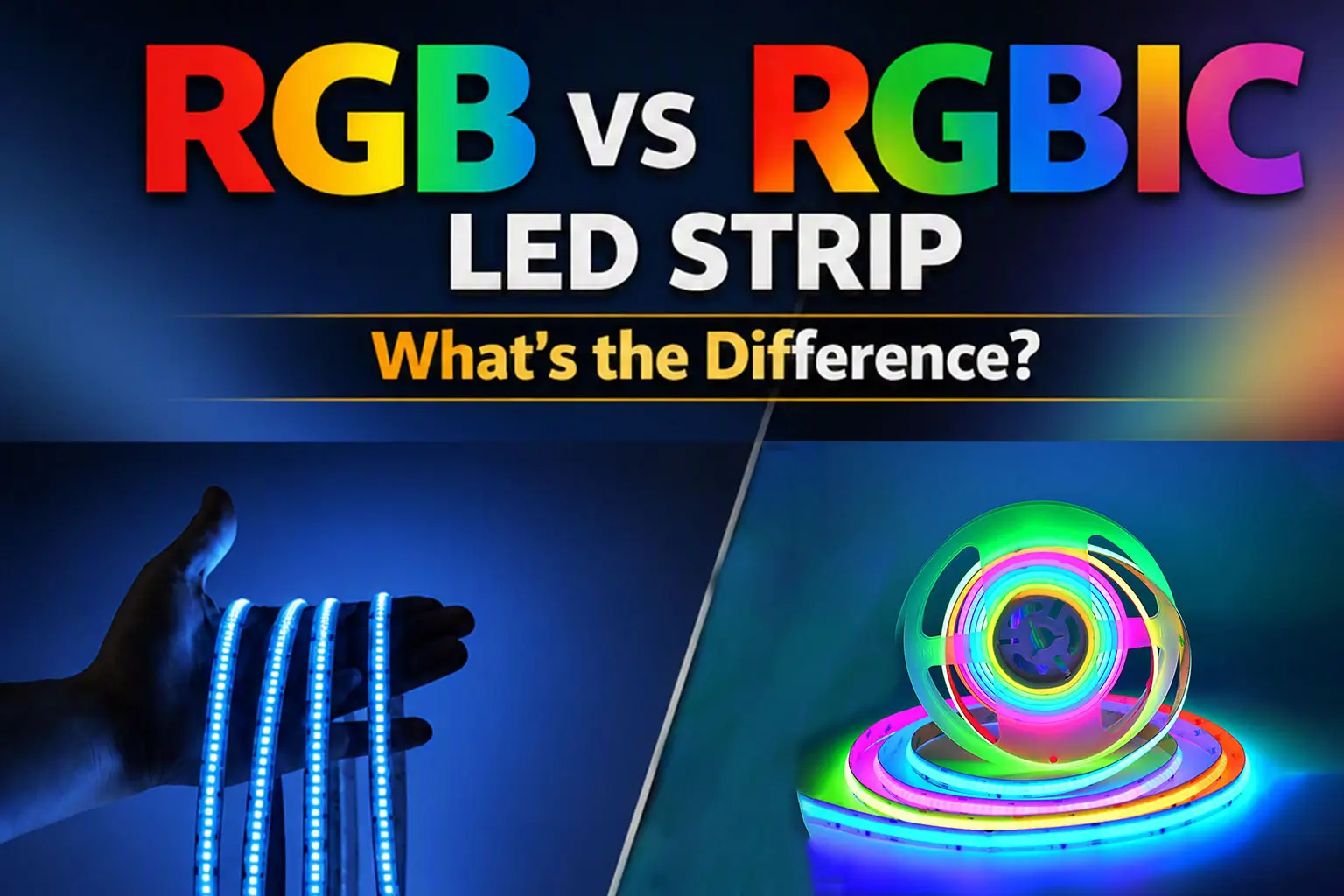
RGB stands for Red, Green, and Blue.
A standard RGB LED strip uses these three color channels to mix different colors. By adjusting the brightness of the red, green, and blue channels, the strip can produce colors such as red, green, blue, purple, yellow, cyan, and many other mixed colors.
In a typical standard RGB system, the same controlled section of the strip displays the same color.
For example:
Red → the entire controlled section becomes red
Blue → the entire controlled section becomes blue
Purple → the entire controlled section becomes purple
The strip can change from one color to another, but it normally cannot display red, green, blue, and purple simultaneously at different points along the same controlled section.
Standard RGB LED strips are suitable for applications where the main requirement is color-changing illumination.
Common applications include:
Hotel and restaurant lighting
Bar and entertainment spaces
Villa lighting
Interior decoration
Ceiling cove lighting
Furniture lighting
Retail displays
Landscape accents
Architectural outline lighting
Event decoration
If a project only needs the entire lighting line to change between different colors, standard RGB is usually a practical and cost-effective solution.
RGBIC stands for RGB with an Integrated Circuit (IC).
The IC is used to control different sections of the LED strip independently.
Instead of treating the entire strip as one lighting zone, an RGBIC strip can divide the strip into multiple controllable segments.
For example, an RGBIC strip could display:
Red → Orange → Yellow → Green → Blue → Purple
at the same time along different sections.
The colors can then move along the strip to create a dynamic effect.
This is why RGBIC LED strips are often associated with:
Chasing effects
Running effects
Rainbow effects
Gradient effects
Wave effects
Dynamic color transitions
Pixel-style effects
The key difference is therefore not simply that RGBIC has “more colors.”
The important difference is independent control of multiple sections or pixels.
The easiest way to understand the difference is to look at how each strip is controlled.
| Feature | Standard RGB LED Strip | RGBIC LED Strip |
|---|---|---|
| Color channels | Red, Green, Blue | Red, Green, Blue + control IC |
| Whole-section color changing | Yes | Yes |
| Multiple colors at the same time | Usually no | Yes |
| Independent segment control | No | Yes |
| Chasing effects | Usually no | Yes |
| Running effects | Usually no | Yes |
| Rainbow effects | Usually no | Yes |
| Gradient effects | Limited | Yes |
| Pixel-style effects | No | Yes |
| Control system | Relatively simple | More advanced |
| Cost | Usually lower | Usually higher |
| Best for | Basic color changing | Dynamic lighting effects |
The exact capabilities depend on the LED strip design, control IC, controller, and number of independently controlled pixels or segments.
A conventional RGB LED strip generally has separate channels for red, green, and blue.
The controller adjusts these channels to create different colors.
For example:
R = 100%
G = 0%
B = 0%
creates red.
If red and blue are mixed:
R + B → Purple
If red and green are mixed:
R + G → Yellow
The controller is essentially controlling the RGB channels together.
As a result, a standard RGB strip is generally designed to show the same color throughout the same controlled section.
This makes the system relatively simple and economical.
An RGBIC strip adds integrated control circuitry to the strip.
The IC allows the controller to send control information to different sections or pixels.
Instead of saying:
“Make the entire strip blue.”
The system can effectively control different areas:
“Section 1 = red.”
“Section 2 = yellow.”
“Section 3 = green.”
“Section 4 = blue.”
This makes dynamic effects possible.
The exact architecture varies between products. Some RGBIC strips control individual LEDs, while others control groups of LEDs as independent segments.
Therefore, RGBIC does not automatically mean every individual LED is independently controllable.
When purchasing an addressable product, it is important to confirm the actual pixel or segment control specification.
Yes.
This is one of the biggest advantages of RGBIC technology.
A standard RGB strip may look like:
An RGBIC strip can display:
The different sections can then move or transition:
This creates the familiar running and chasing effects often seen in architectural lighting, entertainment spaces, gaming rooms, commercial displays, and landscape projects.
They are closely related, but the terms should not always be treated as exactly identical.
Addressable RGB generally refers to a lighting system where individual LEDs or groups of LEDs can be controlled independently.
RGBIC usually refers to RGB LEDs combined with integrated control ICs that allow segmented or pixel-style control.
The actual control capability depends on the IC and product architecture.
For professional projects, it is better to ask the manufacturer:
What IC is used?
How many LEDs can be controlled independently?
What is the pixel or segment length?
What protocol does it use?
What controller is compatible?
What is the maximum controllable length?
This is much more useful than simply asking whether a product is “RGBIC.”
If your project requires only basic color changing, standard RGB is sufficient.
For example:
Blue → Purple → Red → Green → White
with the whole strip changing together.
RGBIC becomes more useful when you need:
Running → Chasing → Gradient → Rainbow → Wave → Multi-color animation
In other words:
RGB focuses on color changing.
RGBIC focuses on dynamic color control.
Not necessarily.
RGBIC does not automatically mean the LEDs are brighter.
Brightness is influenced by factors such as:
LED type
LED density
LED efficiency
Power consumption
PCB design
Operating voltage
Thermal management
Optical design
An RGBIC strip can have lower power and brightness than a high-power standard RGB strip.
Therefore, RGBIC should not be selected simply because it sounds more advanced.
If brightness is important, compare the actual specifications such as W/m, LED density, LED efficiency, and optical output.
In many cases, yes.
RGBIC strips typically require additional control components and a more sophisticated control system.
The overall system may include:
LED strip + controller + power supply + wiring + control software
A standard RGB system is usually simpler.
However, the price difference depends heavily on:
LED density
IC type
Pixel resolution
PCB quality
Waterproof construction
Voltage
Power
Controller
Production volume
Customization requirements
For a large engineering project, it is more useful to compare the total system cost rather than only the price per meter.
Usually, yes.
A standard RGB controller cannot automatically control every RGBIC or addressable LED strip.
The controller must be compatible with the strip's control architecture and protocol.
Before purchasing an RGBIC LED strip, confirm:
Different ICs may require different control methods.
The controller must support the appropriate protocol.
The controller and LED strip must operate at compatible voltage levels.
The controller must be capable of controlling the required number of pixels or segments.
The controller may have a limit on how much LED strip it can control.
For professional installations, the LED strip, controller, power supply, and distribution system should be designed as one complete system.
No.
This is an important distinction for professional lighting projects.
RGBIC describes a type of LED strip/control architecture involving integrated control ICs.
DMX512 is a professional lighting control protocol.
They are not interchangeable terms.
An addressable LED strip may use a specific IC and data protocol, while DMX512 can be used as part of a larger professional lighting control system.
For architectural and commercial projects, it is therefore important to ask the manufacturer about the complete control system rather than simply asking whether the product is RGBIC.
For example, a project may require:
DMX512 controller → decoder → LED strip
while another application may use:
Controller → SPI/addressable LED strip
The correct solution depends on the project design.
Not necessarily.
Power consumption depends mainly on the LED configuration and operating conditions.
For example, two strips may have very different power ratings:
RGB: 9.6W/m
RGBIC: 14.4W/m
or:
RGB: 14.4W/m
RGBIC: 10W/m
Therefore, RGBIC itself does not determine power consumption.
When comparing products, look at the actual W/m specification.
Also remember that the power supply should be selected based on the maximum expected load and appropriate operating margin.
There is no universal maximum length for every RGBIC strip.
The practical maximum depends on:
Operating voltage
Power consumption
PCB design
Copper thickness
LED density
IC type
Data transmission
Controller capability
Power injection
Wiring design
Long RGBIC installations may require power injection at multiple points.
Otherwise, you may experience:
Reduced brightness
Color inconsistency
Flickering
Data errors
Unstable dynamic effects
For a large project, the manufacturer should provide a recommended maximum run length and power injection method for the specific model.
Both 12V and 24V RGBIC products are available.
For short applications, 12V may be suitable.
For longer professional installations, 24V can often provide advantages because the same power level requires less current.
For example:
A 120W load at 12V requires approximately:
120W ÷ 12V = 10A
At 24V:
120W ÷ 24V = 5A
Lower current can help simplify power distribution and reduce voltage-drop concerns.
However, the correct voltage still depends on the specific strip and controller.
Do not assume that every RGBIC strip can simply be changed from 12V to 24V.
Both can be used outdoors if the product is properly designed for outdoor conditions.
The choice depends primarily on the required effect.
Simple color changing
One color across the lighting line
Straightforward control
Lower system complexity
Cost-effective architectural lighting
Running effects
Chasing effects
Dynamic gradients
Rainbow effects
Multiple colors simultaneously
Interactive or animated lighting
For outdoor applications, however, the waterproof construction is just as important as the control technology.
You should consider:
IP rating
Silicone material
UV resistance
End-cap sealing
Cable exits
Connectors
Operating temperature
Installation method
An RGBIC strip with advanced effects is not necessarily suitable for outdoor use unless its complete construction is designed for that environment.
There is no universal answer.
It depends on the architectural concept.
Building outlines
Simple façade lighting
Hotel decoration
Villa contours
Landscape accents
General color-changing effects
Dynamic façades
Media-style architectural lighting
Moving light effects
Entertainment buildings
Commercial displays
Theme parks
Creative landscape installations
If the lighting design is static or only requires the entire building to change color, RGB can be the more economical choice.
If the lighting design itself is part of the visual experience, RGBIC can provide significantly more creative possibilities.
For commercial projects, the decision should be based on the desired lighting effect and control system rather than simply choosing the more advanced technology.
For example:
Hotel façade
If the client wants the entire façade to change color together, standard RGB may be enough.
Shopping mall entertainment area
If the design includes moving gradients and dynamic effects, RGBIC may be more suitable.
Landscape project
If the lighting needs to follow a programmed sequence, RGBIC or another addressable solution may provide better control.
Large architectural project
A professional control system such as DMX512 may be considered depending on the project's requirements.
This is why project specifications should be confirmed before selecting the LED strip.
A simple decision process can help.
You need simple color changing
The entire lighting section can display the same color
The control system should remain simple
Cost is a major consideration
The project does not require animated effects
You need multiple colors at the same time
You need chasing effects
You need running effects
You need rainbow or gradient effects
You need independently controlled segments
The lighting effect is an important part of the project
You need very high pixel density
You need precise individual LED control
The project requires professional lighting protocols
You need integration with a larger architectural lighting control system
In these cases, it may be better to discuss the complete control architecture with the LED strip manufacturer before choosing the product.
There is no universal winner.
The right choice depends on what you want the lighting to do.
| Requirement | Recommended Choice |
|---|---|
| Basic color changing | RGB |
| Whole strip changes color together | RGB |
| Lower system complexity | RGB |
| Cost-sensitive decorative lighting | RGB |
| Multiple colors at the same time | RGBIC |
| Chasing effect | RGBIC |
| Running effect | RGBIC |
| Rainbow effect | RGBIC |
| Gradient effect | RGBIC |
| Pixel-style animation | RGBIC / Addressable |
| Professional dynamic lighting | Addressable / DMX-based solution depending on system |
The most important question is not:
“Which one is better?”
It is:
“What lighting effect does the project require?”
If you are purchasing RGBIC LED strips for a commercial or engineering project, asking only for the price per meter is usually not enough.
Ask the manufacturer about:
LED type
LED density
Power consumption per meter
Operating voltage
IC model
Pixel/segment control
Control protocol
Recommended controller
Maximum run length
Power injection method
PCB width
Cutting length
IP rating
Silicone construction
Operating temperature
Warranty
Customization options
For larger projects, also provide the manufacturer with:
Total project length
Installation environment
Required lighting effect
Controller system
Installation structure
Expected operating hours
Project location
This information allows the manufacturer to recommend a suitable specification rather than simply offering a standard product.
For small residential projects, customers can often select a standard RGB or RGBIC product based on basic specifications.
For larger commercial and engineering projects, product selection becomes more complicated.
The required combination of voltage, LED density, power, IP rating, PCB width, IC, control protocol, and maximum run length can vary significantly from one project to another.
ZBL Lighting focuses on LED strip manufacturing and professional lighting applications, providing RGB, addressable RGB, RGBW, COB, waterproof, and other LED strip solutions for distributors, contractors, lighting companies, and project buyers.
For project-based orders, the recommended product can be selected according to the actual application rather than simply choosing a standard RGBIC strip from a catalog.
This is particularly useful for projects involving:
Architectural façades
Landscape lighting
Hotels and resorts
Commercial buildings
Villas
Entertainment spaces
Retail environments
Theme parks
Outdoor lighting
Dynamic decorative lighting
For engineering projects, providing the project length, installation environment, required lighting effect, voltage, and control system in advance can make product selection much more accurate.
Before placing an order, confirm the following specifications.
RGB or RGBW?
12V or 24V?
LED density?
Power per meter?
PCB width?
IP rating?
Maximum run length?
Controller type?
Cutting length?
Indoor or outdoor installation?
IC model?
Individual LED or segment control?
Pixel length?
Control protocol?
Compatible controller?
Maximum controllable pixels?
Maximum run length?
Power injection requirement?
12V or 24V?
IP rating?
PCB width?
Cutting interval?
These specifications are much more useful than comparing products based only on the words “RGB” or “RGBIC.”
Not necessarily. RGBIC provides more advanced dynamic effects, but standard RGB is often sufficient for simple color-changing applications.
A conventional RGB strip normally cannot produce true independently controlled chasing effects. If dynamic segment control is required, an RGBIC or other addressable LED strip is more appropriate.
Yes. RGBIC can control different sections independently, allowing multiple colors to appear simultaneously.
They are closely related, but the exact control architecture depends on the product and IC. Always confirm the IC model and actual pixel or segment control capability.
Usually yes. The controller must support the LED strip's voltage, IC, communication protocol, pixel configuration, and control requirements.
Usually, but not always. RGBIC products generally require additional control components and a more advanced system, but the final price depends on the LED density, IC, PCB, waterproof construction, power, and order quantity.
Yes, if the strip is specifically designed for outdoor use with appropriate waterproof construction and IP protection.
For longer professional installations, 24V can provide advantages in current and power distribution. However, the best choice depends on the specific product and project design.
Some addressable LED systems can be integrated with DMX512 through compatible controllers or decoders, but RGBIC itself is not the same thing as DMX512. Compatibility must be confirmed based on the specific IC and control architecture.
The main difference between RGB and RGBIC LED strips is independent control.
A standard RGB LED strip is designed primarily for straightforward color-changing lighting. It is simple, practical, and suitable for many decorative, architectural, landscape, and commercial applications.
RGBIC adds integrated control circuitry that allows different sections or pixels to be controlled independently. This makes it possible to create chasing, running, rainbow, gradient, and other dynamic effects.
So the decision is straightforward:
Choose RGB when you need simple, synchronized color changing.
Choose RGBIC when you need dynamic effects and multiple colors at the same time.
For professional projects, however, the choice should go beyond RGB vs RGBIC. Voltage, LED density, power consumption, IC type, control protocol, IP rating, maximum run length, power injection, and installation environment should all be considered together.
The best LED strip is not necessarily the most advanced one.
It is the one that matches the lighting effect, control system, and installation conditions of the actual project.
Need professional help? Contact our team for expert support and personalized solutions. We’re here to assist you. Contact Us



Mobile:+86 18923408595
Email:info@zbl-lighting.com
Zip Code: 518106
Xin Wei Forth industrical Zone,Gong Ming Town,Guangming New Area,Shen Zhen,Guangdong,China