High Quality OEM/ODM LED Strip Manufacturer

High Quality OEM/ODM LED Strip Manufacturer
Published: July 17, 2026 Updated: July 17, 2026 922
Modern villas are no longer illuminated solely for visibility—they are designed to create architectural identity. Exterior LED strip lighting has become one of the most effective ways to highlight rooflines, façades, balconies, and architectural details, transforming a building into a striking nighttime landmark.
However, the quality of an exterior lighting project depends not only on the LED strip itself but also on proper installation. Poor mounting methods, inadequate waterproofing, voltage drop, or visible light dots can significantly reduce the overall appearance and long-term reliability of the system.
With over 15 years of experience in LED strip manufacturing, ZBL Lighting shares this professional guide to installing LED strip lights on villa exteriors, covering installation methods, engineering practices, and key considerations for long-lasting architectural lighting.
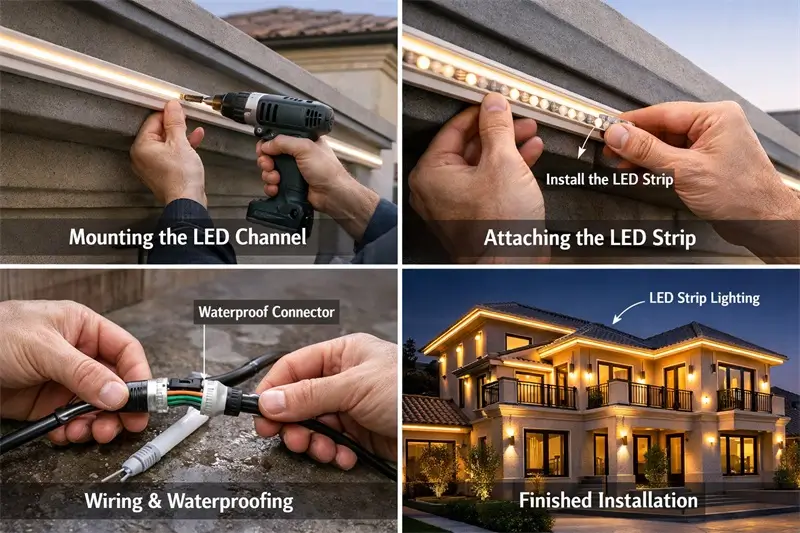
Building outline lighting is a lighting technique that uses LED strip lights to emphasize the architectural lines of a structure, including roof edges, parapets, balconies, columns, and façade details.
The goal is simple:
See the light, not the fixture.
Professional architectural lighting hides the light source during the day while delivering a seamless, uniform glow at night. This design philosophy is widely adopted in luxury villas, boutique hotels, resorts, commercial buildings, and high-end residential projects worldwide.
Roof eaves are the most common installation location for exterior LED strips.
The lighting fixture is concealed beneath the eave, allowing only the light to illuminate the building façade.
Advantages:
Recommended: ★★★★★
Modern villas with flat roofs often integrate LED strips beneath parapet caps.
This creates a clean, floating outline around the roofline and enhances the building's architectural depth.
Recommended: ★★★★★
Installing LED strips beneath balcony slabs or inside handrails adds dimension to the building façade and creates a refined nighttime appearance.
Lighting around entrances improves visibility while emphasizing the main architectural focal point.
Warm white lighting is typically preferred for luxury residential projects.
Many premium villas include grooves or recessed channels designed specifically for concealed linear lighting.
This installation method delivers the highest visual quality while keeping the fixtures invisible during daylight.
A professional architectural lighting project typically follows these steps:
Every stage plays an important role in ensuring long-term performance and a premium lighting effect.
Although adhesive backing may seem convenient, it is not suitable for permanent outdoor architectural lighting.
Direct adhesive installation can result in:
Professional projects instead use:
Aluminum mounting profiles + Stainless Steel Clips + Waterproof Sealing
This approach significantly improves durability and appearance.
Aluminum profiles are much more than simple mounting accessories.
They provide several engineering advantages:
Efficient thermal management helps extend LED lifespan and maintain stable brightness.
Profiles prevent bending or waviness, ensuring perfectly straight lighting lines.
Mechanical fastening withstands outdoor wind loads far better than adhesive mounting.
A concealed aluminum profile creates a clean architectural finish suitable for luxury residential projects.
For exterior installations, mechanical fixing is strongly recommended.
Typical recommendations include:
Proper fixing prevents movement caused by wind, vibration, and thermal expansion.
Waterproofing is one of the most critical aspects of outdoor lighting.
Every electrical connection should be protected using:
Special attention should be given to:
Proper sealing greatly reduces maintenance costs and extends system lifespan.
Most professional architectural lighting systems operate on DC24V constant-voltage power.
Advantages include:
Best practices include:
Visible LED dots reduce the premium appearance of architectural lighting.
To create a smooth, continuous light line, consider using:
Silicone Neon Flex is one of the most popular solutions for luxury villas because it delivers soft, continuous illumination without visible LED hotspots.
For projects requiring animated lighting effects, addressable lighting systems can be integrated.
Common control protocols include:
Compared with standard static lighting, dynamic systems require additional components such as:
DMX512 is widely used for hotels, resorts, commercial buildings, cultural attractions, and landmark architecture.
| Item | Recommended Specification |
|---|---|
| Operating Voltage | DC24V |
| Light Source | COB LED Strip or Silicone Neon Flex |
| Color Temperature | 2700K–3000K Warm White |
| Protection Rating | IP67 / IP68 |
| CRI | ≥90 |
| Mounting Method | Aluminum Profile + Mounting Clips |
| Control System | Static, PWM, DALI, DMX512, SPI |
| Power Supply | Waterproof Constant Voltage Driver |
| Service Life | ≥50,000 Hours |
Avoid the following issues during installation:
Following professional installation practices ensures better lighting quality, improved reliability, and reduced maintenance costs.
ZBL Lighting is a professional LED strip light manufacturer specializing in high-performance linear lighting solutions for architectural, commercial, and landscape projects worldwide.
We provide:
Our engineering team supports customers with product selection, customized solutions, and reliable manufacturing for projects of every scale.
Successful villa exterior lighting depends on much more than selecting a quality LED strip. Professional installation methods, concealed mounting, effective waterproofing, proper power distribution, and high-performance lighting products all contribute to the final result.
For premium residential projects, we recommend using concealed installation, aluminum mounting profiles, DC24V power systems, IP67/IP68 waterproof protection, and dot-free Silicone Neon Flex to achieve elegant architectural lighting with long-term reliability.
Whether you are an architect, lighting designer, contractor, or distributor, choosing the right installation method will ensure your project delivers exceptional visual impact while minimizing future maintenance.
For product selection and project planning, see our outdoor architectural lighting solutions.
Need professional help? Contact our team for expert support and personalized solutions. We’re here to assist you. Contact Us
PROJECT & OEM ENQUIRIES
Describe the application and the result you need. Our team will review the electrical, optical and mechanical requirements before recommending a product or sample.
Fields marked * are required. Share what is available—we can help clarify the rest.



Mobile:+86 18923408595
Email:info@zbl-lighting.com
Zip Code: 518106
Xinwei Fourth Industrial Zone, Gongming Subdistrict, Guangming District, Shenzhen, Guangdong, China