High Quality OEM/ODM LED Strip Manufacturer

High Quality OEM/ODM LED Strip Manufacturer
July 28, 2026 16
Choosing the right RGB LED strip is not simply about finding the brightest product or the lowest price. The right choice depends on where the strip will be installed, what lighting effect you need, how long the installation is, how it will be controlled, and whether it will be exposed to moisture, heat, UV, or weather.
For a small indoor project, a basic 12V RGB LED strip may be sufficient. For a long architectural lighting project, a 24V RGB strip with appropriate power distribution, controller compatibility, and waterproof protection may be a much better solution.
This guide explains the most important factors to consider when choosing an RGB LED strip, helping homeowners, lighting designers, contractors, distributors, and project buyers compare products based on actual requirements rather than marketing claims.
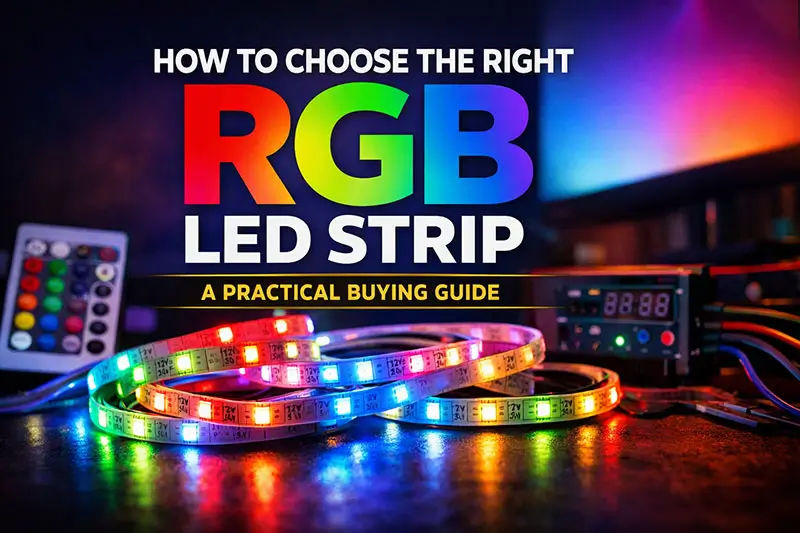
An RGB LED strip uses three primary color channels: red, green, and blue. By adjusting the output of these three channels, the strip can create a wide range of colors.
Unlike single-color LED strips, RGB LED strips are mainly designed for color-changing and decorative lighting applications.
Common applications include:
Architectural accent lighting
Hotel and hospitality projects
Bars and restaurants
Commercial buildings
Retail displays
Gaming rooms
Home entertainment areas
Landscape lighting
Garden and poolside lighting
Villa exterior lighting
Event and holiday decoration
Stage and entertainment projects
However, RGB LED strips are not all the same. Voltage, LED density, power consumption, waterproof construction, PCB design, control method, and installation conditions can all affect the final result.
Before comparing LED density, wattage, or IP ratings, determine what the RGB LED strip needs to do.
Consider whether the application is:
Indoor
Outdoor
Landscape
Architectural
Commercial
Hospitality
Underwater
Decorative
Entertainment
An RGB strip installed inside a ceiling cove has very different requirements from one installed around the exterior of a building or near a swimming pool.
Determine whether you need:
The entire strip to display one color at a time
RGB color changing
RGB plus dedicated white light
Multiple colors at the same time
Chasing effects
Running effects
Gradient effects
Pixel-by-pixel animations
This decision will help determine whether standard RGB, RGBW, or addressable RGB is appropriate.
Total length affects:
Voltage selection
Power consumption
Voltage drop
Power injection
Wiring
Controller capacity
Installation cost
For commercial and architectural projects, the electrical design should be considered before finalizing the LED strip specification.
This is one of the most common areas of confusion when choosing an LED strip.
A standard RGB strip uses red, green, and blue channels.
It is a practical option when the primary purpose is colorful decorative lighting.
Typical applications include:
Decorative lighting
Color-changing effects
Entertainment spaces
Landscape accents
Architectural color lighting
Standard RGB does not have a dedicated white LED channel. White is created by mixing the RGB channels, so it generally does not provide the same white-light performance as a dedicated white LED.
RGBW adds a dedicated white LED channel to RGB.
This is useful when a project requires both colorful effects and functional white illumination.
For example, a hotel may want colorful lighting during special events but warm white or neutral white lighting during normal operation.
If white-light quality is an important part of the project, RGBW is generally more suitable than standard RGB.
Addressable RGB strips use integrated control ICs to control individual LEDs or groups of LEDs.
A standard RGB strip may display the same color along the connected section. An addressable strip can display different colors at different points along the strip and create dynamic animations.
Typical applications include:
Running effects
Chasing effects
Gradient effects
Pixel animations
Dynamic architectural lighting
Entertainment installations
The key difference is not simply the number of colors. It is how the LEDs are controlled.
| Type | Main Advantage | Typical Application |
|---|---|---|
| RGB | Simple color changing | Decorative lighting |
| RGBW | RGB + dedicated white | Hotels, interiors, commercial lighting |
| RGBIC / Addressable RGB | Independent zones or pixels | Dynamic effects and animations |
If you only need the entire strip to change from blue to red to green, standard RGB may be enough.
If you want a moving rainbow, chasing effect, or multi-color animation, an addressable RGB strip is more suitable.
If you need both colorful effects and high-quality white light, consider RGBW.
12V and 24V are two common voltage options for RGB LED strips.
12V RGB strips can be a practical choice for:
Short installations
Furniture
Cabinets
Small decorative projects
DIY applications
Short runs where power distribution is simple
For small indoor applications, 12V can be convenient and easy to integrate with compatible power supplies and controllers.
24V is often a better option for longer installations and professional projects.
For the same power level, a higher-voltage system generally requires less current.
For example, a 120W system requires:
120W ÷ 12V = 10A
At 24V:
120W ÷ 24V = 5A
Lower current can simplify cable sizing and power distribution.
This is one reason 24V RGB LED strips are frequently considered for longer architectural, commercial, and landscape lighting projects.
Not necessarily.
Voltage alone does not determine the maximum run length.
The actual result also depends on:
Power consumption per meter
PCB design
Copper thickness
LED density
Circuit configuration
Power injection
Wiring method
For short indoor projects, 12V can work well.
For longer professional installations, 24V is often more practical, but the final specification should be calculated according to the project.
LED density refers to how many LEDs are installed per meter.
Common specifications include:
30 LEDs/m
60 LEDs/m
96 LEDs/m
120 LEDs/m
240 LEDs/m
Higher LED density generally means the light sources are closer together.
This can help create a smoother appearance, especially when the strip is installed close to a diffuser or viewed directly.
However, higher LED density does not automatically mean better performance.
You should also consider:
Total wattage per meter
LED efficiency
PCB quality
Heat dissipation
Color consistency
Optical design
Installation distance from the diffuser
For professional projects, LED density should be evaluated together with the optical design and installation method.
Traditional SMD RGB strips use individual LED packages mounted on the PCB.
COB technology places LED chips directly on the circuit board and uses a continuous light-emitting layer to create a more uniform line of light.
One major visual advantage of COB RGB LED strips is the reduced appearance of individual light points.
COB RGB can be particularly useful for:
Linear architectural lighting
Furniture
Shelving
Cabinets
Interior decoration
Close-view applications
Installations where visible LED dots are undesirable
If the RGB strip will be installed inside an aluminum profile with a diffuser, conventional SMD RGB may already provide a satisfactory result.
If the strip is close to the viewer and a continuous visual appearance is important, COB RGB is worth considering.
If the RGB LED strip will be installed outdoors or in a wet environment, waterproof protection becomes an important selection factor.
Common IP ratings include:
IP20
IP65
IP67
IP68
The appropriate rating depends on the actual installation environment.
Generally suitable for dry indoor locations.
Typical applications include:
Bedrooms
Living rooms
Cabinets
Display shelves
Interior ceilings
Provides protection against dust and water spray and can be suitable for certain outdoor or semi-outdoor applications depending on the product construction.
Provides a higher level of protection and can be considered for outdoor architectural and landscape applications where the strip may be exposed to rain or temporary water immersion.
Designed for applications requiring a higher level of water protection and, depending on the specific product construction, continuous or deeper immersion.
Potential applications include:
Pools
Water features
Fountains
Marine environments
Underwater lighting
The IP number should not be considered in isolation.
Waterproof performance can also depend on:
Silicone material
Extrusion construction
End caps
Cable exits
Connectors
Sealing method
Installation quality
For outdoor projects, the complete lighting system should be evaluated rather than looking only at the IP rating printed on the strip.
Power consumption is one of the most important specifications when selecting an RGB LED strip.
Typical products may be rated at:
4.8W/m
9.6W/m
12W/m
14.4W/m
18W/m
20W/m or higher
Higher wattage does not automatically mean better quality.
More power may provide higher output, but it can also increase:
Heat generation
Power supply requirements
Cable requirements
Energy consumption
Thermal management requirements
Use the basic formula:
Total strip power = Power per meter × Total length
For example, if the strip consumes 12W/m and the project requires 20 meters:
12W × 20m = 240W
The power supply should not normally be selected to operate continuously at its absolute maximum rated capacity. An appropriate safety margin should be considered according to the power supply manufacturer's recommendations.
For long installations, power distribution should also be planned instead of connecting the entire length from one end.
One of the most common installation mistakes is assuming that an entire reel can be powered from one end.
As electrical current travels through the PCB, voltage drop can occur.
Typical symptoms include:
The beginning is brighter than the end
Colors become inconsistent
The far end becomes dim
Certain colors appear weaker
Flickering occurs at the end of a long run
Depending on the project, solutions may include:
Choosing 24V instead of 12V
Reducing the length of each continuous run
Adding power injection
Feeding power from multiple points
Using appropriately sized cables
Dividing the installation into multiple circuits
For commercial and architectural projects, the power distribution plan should be designed together with the LED strip selection.
This is also an area where working directly with an experienced LED strip manufacturer can be useful. A professional manufacturer should be able to review the project length, wattage, voltage, and installation method before recommending the final configuration.
The controller and LED strip must be electrically and functionally compatible.
For standard RGB strips, check:
Voltage
Number of channels
Current capacity
Control method
Connection type
For addressable RGB strips, additional specifications may be required.
These can include:
IC type
Data protocol
Pixel or segment control
Data direction
Operating voltage
Maximum number of controllable pixels
Controller software compatibility
For projects using DMX512, SPI, Wi-Fi, Bluetooth, or other control systems, confirm compatibility before purchasing.
A common mistake is to choose the LED strip first and then try to find a controller afterward.
For professional projects, it is better to confirm the strip + controller + power supply as a complete system.
RGB LED strips are available in different PCB widths, including:
5mm
8mm
10mm
12mm
15mm
20mm or wider
PCB width becomes especially important when the strip needs to fit inside:
Aluminum profiles
Cabinets
Architectural grooves
Furniture
Custom lighting channels
Before purchasing, check:
Strip width + profile width + connector dimensions
A technically suitable strip may still be unsuitable if it does not physically fit the installation channel.
RGB LED strips cannot necessarily be cut at any point.
The cutting interval is determined by the circuit design.
Depending on the product, the cutting distance may be:
25mm
50mm
100mm
Another manufacturer-specific interval
If the project requires precise lengths, a shorter cutting interval can reduce material waste and make installation easier.
Always follow the actual cutting marks printed on the LED strip.
LED strips generate heat during operation.
This becomes increasingly important for high-power RGB strips, long operating hours, commercial projects, and high-temperature environments.
For higher-power installations, an aluminum profile can provide mechanical support and improve thermal management.
Heat management should be considered carefully for:
High-power RGB LED strips
Long operating hours
Commercial projects
High ambient temperatures
Enclosed installations
A lighting system should be evaluated not only by how bright it looks when first switched on, but also by how consistently it performs during long-term operation.
Brightness is only one part of LED strip performance.
When comparing products, consider:
Color consistency
LED density
Power efficiency
PCB quality
Voltage stability
Heat dissipation
Waterproof construction
Controller compatibility
Color mixing
Expected service life
Warranty
Batch consistency
For a small decorative project, price may be an important factor.
For a hotel, commercial building, landscape project, or large architectural installation, long-term reliability and batch consistency can be much more important.
Replacing a complete installed lighting system can cost significantly more than choosing the right product at the beginning.
Different applications require different specifications.
| Application | Key Selection Considerations |
|---|---|
| Bedroom / Living Room | 12V or 24V, standard RGB, indoor-rated product |
| Gaming Room | RGB or addressable RGB, high density, dynamic control |
| Cabinet / Furniture | Narrow PCB, suitable LED density, low heat |
| Hotel / Restaurant | RGBW or RGB, reliable controller, good color consistency |
| Villa Exterior | 24V, suitable outdoor IP rating, proper power distribution |
| Landscape Lighting | Waterproof construction, 24V, suitable connectors |
| Pool / Water Feature | Properly engineered underwater-rated system |
| Commercial Façade | 24V, robust waterproof construction, long-term reliability |
| Dynamic Architecture | Addressable RGB, compatible controller, suitable data system |
| Large Engineering Project | 24V, power injection, professional control and distribution |
This table is a starting point rather than a universal specification. The final selection should be based on the actual project environment, total length, power requirements, control system, and installation structure.
If LED specifications seem complicated, the selection process can be simplified into eight steps.
Indoor, outdoor, landscape, architectural, commercial, decorative, or entertainment?
Do you need:
One color at a time?
RGB color changing?
RGB + white?
Multiple colors simultaneously?
Running or chasing effects?
For short installations, 12V may be sufficient.
For longer or professional installations, 24V is often worth considering.
Choose between:
SMD RGB
COB RGB
RGBW
Addressable RGB
based on the required visual effect and control system.
Dry indoor environment → lower IP protection may be sufficient.
Outdoor or wet environment → select a suitable waterproof construction.
Underwater application → use a properly engineered underwater-rated product.
Use:
W/m × total meters = total LED strip power
Then select the power supply, wiring, and distribution method based on the calculated load.
Make sure the controller matches the strip's:
Voltage
Current
Channels
Protocol
Control requirements
Check:
Strip width
Cutting interval
Maximum recommended run
Power injection
Aluminum profile compatibility
Connectors
Waterproof cable exits
Mounting method
This process can eliminate many of the problems that otherwise appear after installation.
A low purchase price does not necessarily mean a lower total project cost.
Poor PCB materials, inconsistent LEDs, weak waterproofing, or insufficient thermal management can result in premature failures.
Long runs powered from only one end can produce uneven brightness and inconsistent colors.
An RGB strip with a silicone coating is not automatically suitable for outdoor or underwater use.
The complete waterproof construction matters.
The controller must match the strip's electrical and control specifications.
If high-quality white illumination is required, RGBW may be a better choice than standard RGB.
LED density matters, but it should be evaluated together with LED efficiency, power consumption, PCB design, thermal performance, and optical requirements.
A high-quality LED strip may still be unsuitable if it does not fit the profile, cannot dissipate heat, or is installed beyond its recommended run length.
For small residential projects, buying through a local retailer or distributor may be the simplest option.
For larger projects, however, working directly with an RGB LED strip manufacturer can provide additional advantages.
A manufacturer can often help with:
Product selection
Voltage selection
LED density
PCB width
IP rating
Custom lengths
Power requirements
Controller matching
Waterproof construction
OEM / ODM requirements
Bulk production
Project-specific specifications
This can be particularly useful when the project requires a non-standard combination of voltage, width, LED density, waterproof construction, color temperature, or control method.
ZBL Lighting is an LED strip manufacturer focused on professional lighting applications and bulk project requirements. For contractors, distributors, lighting companies, and engineering buyers, the product can be selected according to the actual installation environment, required lighting effect, voltage, length, and control system.
Instead of simply asking for the price per meter, it is usually more useful to provide the manufacturer with the project specifications first.
If you want a manufacturer to recommend the right RGB LED strip, prepare the following information:
1. Application
For example: hotel, villa, landscape, façade, garden, retail store, pool, or interior decoration.
2. Total Length
For example: 30m, 100m, 500m, or 1,000m.
3. Installation Environment
Indoor, outdoor, wet, underwater, high-temperature, or exposed to direct sunlight.
4. Required Lighting Effect
Standard RGB, RGBW, chasing, running, gradient, pixel effects, or other dynamic effects.
5. Voltage
12V or 24V, if already determined.
6. Control System
Standard RGB controller, DMX512, SPI, Wi-Fi, Bluetooth, or another system.
7. Physical Requirements
Strip width, cutting length, profile dimensions, cable direction, and installation method.
Providing this information allows the manufacturer to recommend a more suitable specification and reduces the risk of selecting an unsuitable product.
There is no single RGB LED strip that is best for every application.
The best RGB LED strip is the one that matches the project's:
Lighting effect + voltage + power + length + environment + control system + installation method.
For a short indoor decorative project, a basic 12V RGB strip may be sufficient.
For a long architectural project, a 24V RGB strip with appropriate power injection and professional control may be more suitable.
For smooth, continuous linear lighting, COB RGB can be a better option.
For running effects and multi-color animations, addressable RGB is usually more appropriate.
For applications that require both colorful effects and useful white illumination, RGBW is worth considering.
The goal is not to buy the most expensive RGB LED strip.
The goal is to choose the right specification for the actual application.
Before placing an order, confirm the following:
Application: Indoor / Outdoor / Landscape / Architectural
Voltage: 12V / 24V
LED Technology: SMD / COB / RGBW / Addressable
LED Density: LEDs per meter
Power: W/m
Strip Width: mm
IP Rating: IP20 / IP65 / IP67 / IP68
Color Control: Standard RGB / RGBW / Addressable
Controller: Compatible with the selected strip
Maximum Run: Confirm with the manufacturer
Power Injection: Required or not
Cutting Length: Confirm cutting interval
Installation: Aluminum profile / clips / adhesive / custom mounting
Operating Environment: Temperature, moisture, UV exposure, and water exposure
Warranty: Confirm warranty terms and expected service conditions
If these specifications are clear before purchasing, it becomes much easier to compare different RGB LED strip manufacturers and avoid expensive installation problems.
Choosing an RGB LED strip should start with the application, not the product price.
For basic color-changing lighting, standard RGB is often enough. For projects that require useful white light, RGBW provides a dedicated white channel. For dynamic effects such as chasing, gradients, and multi-color animations, addressable RGB provides much greater control. COB RGB is worth considering when a smoother, more continuous appearance is important.
For professional projects, voltage, wattage, LED density, IP rating, maximum run length, controller compatibility, power distribution, and thermal management should all be considered before the final product is selected.
If you are purchasing RGB LED strips for a commercial or engineering project, it is worth providing the manufacturer with the application, total length, installation environment, required effect, voltage preference, and control system.
A reliable manufacturer should be able to recommend a suitable specification instead of simply quoting a price per meter.
For distributors, contractors, lighting companies, and project buyers, ZBL Lighting can provide RGB LED strip solutions for architectural, landscape, commercial, hospitality, and other professional lighting applications, with specifications selected according to project requirements.
The right RGB LED strip is not necessarily the brightest or cheapest one.
It is the one that performs reliably in the environment where it will actually be used.
Need professional help? Contact our team for expert support and personalized solutions. We’re here to assist you. Contact Us



Mobile:+86 18923408595
Email:info@zbl-lighting.com
Zip Code: 518106
Xin Wei Forth industrical Zone,Gong Ming Town,Guangming New Area,Shen Zhen,Guangdong,China