High Quality OEM/ODM LED Strip Manufacturer

High Quality OEM/ODM LED Strip Manufacturer
Published: November 16, 2026 Updated: November 16, 2026 17
Choosing a reliable LED strip manufacturer in China requires more than comparing prices and product catalogs. Buyers should verify the manufacturer's production capabilities, technical specifications, quality control procedures, certifications, and ability to maintain consistent performance across orders. The safest approach is to request detailed product specifications, evaluate physical samples, verify compliance documents, and confirm production requirements before placing a bulk order.
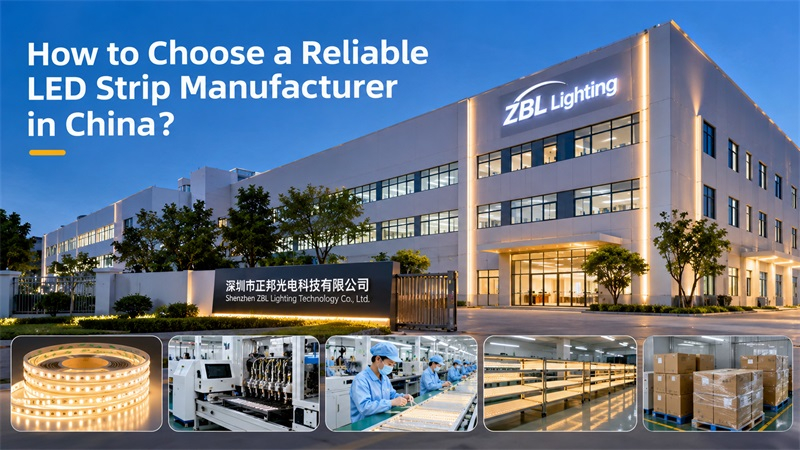
China is one of the world's major manufacturing centers for LED lighting products, with Shenzhen and surrounding industrial areas hosting numerous LED strip manufacturers, component suppliers, and lighting technology companies.
For international buyers, this manufacturing ecosystem offers access to a wide range of products, competitive production costs, and customization opportunities.
However, not every supplier operates with the same engineering capabilities or quality management practices.
Two LED strips may appear nearly identical in product photos while performing very differently after installation.
Differences in LED chips, printed circuit board (PCB) construction, current regulation, thermal design, and protective materials can influence brightness, color consistency, voltage drop, and long-term reliability.
For example, a lighting contractor installing 500 meters of LED strips in a hotel may encounter substantial replacement costs if the products develop uneven brightness, premature failures, or color differences between production batches.
The initial purchase price is only one part of the project's total cost.
A dependable manufacturer should help buyers avoid these problems before production begins.
One of the first decisions when sourcing LED strips from China is whether to work directly with a manufacturer or through a trading company.
Both can be suitable depending on the purchasing requirements.
| Comparison | LED Strip Manufacturer | Trading Company |
|---|---|---|
| Production | Manufactures products directly or operates dedicated production processes | Sources products from one or more factories |
| Customization | Generally better positioned for engineering changes | Depends on manufacturing partners |
| Technical support | May provide direct access to production engineers | Depends on supplier relationships |
| Product selection | Often focused on specific manufacturing capabilities | May offer a broader product range |
| Quality control | Can manage production inspection directly | Requires supplier coordination or independent inspection |
| Pricing | May offer more direct factory pricing | May include additional sourcing and service costs |
| Suitable buyers | OEM brands, distributors, project contractors | Buyers sourcing multiple product categories |
When should you choose a manufacturer?
Direct manufacturing relationships are particularly useful for projects requiring customized PCB widths, special color temperatures, waterproof construction, long production runs, or strict batch consistency.
For example, an architectural lighting company may need a 24V LED strip with a particular brightness, color temperature, PCB width, and cutting interval.
A manufacturer with engineering and production capabilities can evaluate whether those requirements are technically feasible.
When might a trading company be useful?
A trading company can be a practical option when buyers need different lighting products from multiple factories but prefer to coordinate purchasing through one supplier.
The important distinction is not simply whether a company calls itself a factory.
It is whether the supplier can demonstrate control over product specifications, manufacturing quality, and after-sales responsibilities.
Before establishing a purchasing relationship, consider requesting:
A valid business registration document and the legal company name.
Recent factory photos or a live video walkthrough.
Information about SMT assembly, soldering, coating, extrusion, aging, and packaging processes.
Product inspection procedures and available testing equipment.
Examples of products manufactured under the company's own brand or OEM arrangements.
The factory's actual address and the location of the relevant production processes.
A factory does not necessarily perform every operation internally. Some processes may be outsourced to specialized partners.
What matters is whether the supplier clearly explains its manufacturing arrangements and maintains appropriate quality controls.
A professional LED strip manufacturer should be able to explain product specifications beyond LED quantity and wattage.
Buyers should pay particular attention to electrical performance, optical characteristics, PCB construction, and environmental protection.
LED chip selection influences luminous output, color performance, and reliability.
A higher LED density does not automatically guarantee a brighter or more efficient product.
For example, a 480 LEDs/m COB strip may produce less light than another strip with fewer emitters if its operating current, chip efficiency, or thermal design differs.
Instead of comparing LED quantities alone, request the following information:
| Parameter | What Buyers Should Check | Why It Matters |
|---|---|---|
| LED density | LEDs/m | Affects light distribution and appearance |
| Input voltage | V DC | Determines driver and wiring compatibility |
| Power consumption | W/m | Affects electrical loading and heat generation |
| Luminous flux | lm/m | Indicates measured light output |
| Luminous efficacy | lm/W | Helps compare energy efficiency |
| Color temperature | K | Determines the appearance of white light |
| Color rendering index | CRI (Ra) | Indicates general color rendering performance |
| Color consistency | SDCM or chromaticity tolerance | Helps control visible differences between strips |
| PCB width | mm | Determines compatibility with profiles and mounting spaces |
| Cut interval | mm | Influences installation flexibility |
| Ingress protection | IP rating | Indicates tested resistance to dust and water ingress |
For architectural projects, request the measurement conditions as well as the reported values.
A useful photometric report should identify the tested product, applied voltage, operating condition, measurement method, and relevant environmental conditions.
Color quality matters particularly in hotels, retail stores, restaurants, and premium residential applications.
CRI 80 may be sufficient for many general decorative applications, while CRI 90 or higher is frequently specified where accurate color rendering is important.
However, CRI alone does not describe every aspect of color quality.
Two LED strips can have similar CRI values but noticeably different white-light appearances.
For projects where several lighting sections must appear uniform, buyers should also discuss chromaticity tolerances, SDCM requirements, and LED binning controls.
For example, a hotel may install warm-white LED strips in hundreds of guest rooms.
If replacement strips come from a different color bin, maintenance teams may notice variations between the original and replacement installations.
A suitable supplier should explain how color consistency is managed across production batches.
The PCB carries electrical current and transfers heat away from the LED components.
Its construction can affect voltage drop, operating temperature, and reliability.
Important PCB questions include:
What is the copper thickness?
What are the PCB width and number of layers?
What is the maximum recommended continuous run length?
What is the expected voltage drop at the end of the run?
What mounting or cooling conditions are required?
Common PCB copper weights include 1 oz and 2 oz, corresponding to nominal copper thicknesses of approximately 35 µm and 70 µm, respectively.
However, thicker copper does not automatically guarantee better performance.
Trace geometry, total current, connector resistance, installation temperature, and power-feed arrangement also influence electrical and thermal behavior.
A reliable manufacturer should evaluate the complete installation rather than recommend a PCB solely by copper weight.
A manufacturer may offer hundreds of LED strip models, but a larger catalog does not necessarily mean better engineering support.
The manufacturer should be able to recommend appropriate technology based on the actual application.
| LED Strip Type | Main Advantage | Typical Application | Important Consideration |
|---|---|---|---|
| SMD LED Strip | Versatile, widely available configurations | General lighting, coves, cabinets | LED dots may be visible in shallow installations |
| COB LED Strip | Smooth, continuous light appearance | Furniture, retail displays, architectural details | Thermal management and strip construction |
| RGB LED Strip | Adjustable color output | Entertainment spaces, decorative lighting | RGB-mixed white may be unsuitable for task lighting |
| RGBW LED Strip | Color effects with a dedicated white channel | Hotels, restaurants, architectural projects | Four-channel controller compatibility |
| Addressable LED Strip | Individual pixel or segment effects | Facades, entertainment, landscape projects | Protocol, controller, pixel mapping |
| LED Neon Flex | Diffused linear light with flexible enclosure | Building outlines, signage, landscape features | Bend direction, minimum radius, waterproof termination |
For example, a furniture manufacturer seeking a smooth, continuous light line inside a shallow aluminum profile may prefer COB strips.
An architectural lighting contractor working on a dynamic building facade may require addressable strips using a compatible SPI or DMX512 control system.
These products serve different purposes.
Selecting the wrong technology can create installation difficulties even when the product itself meets its published specifications.
Before recommending a model, the manufacturer should understand the installation environment, lighting effect, mounting dimensions, electrical system, and control requirements.
Ordering samples is one of the most useful steps in supplier qualification.
However, simply connecting a sample to a power supply and checking whether it lights up is not enough.
Buyers should perform a structured evaluation under conditions representative of the intended project.
Use a suitable DC power meter or measure voltage and current at the strip input.
For a DC-powered LED strip:
Electrical power (W) = Voltage (V) × Current (A)
For example, suppose a 5-meter LED strip draws 3.0 A from a regulated 24V power supply.
Its measured input power is:
24V × 3.0A = 72W
Power per meter:
72W ÷ 5m = 14.4W/m
Compare the result with the manufacturer's specification.
A difference may be caused by manufacturing variation, supply voltage, measurement conditions, or other factors.
It should be investigated rather than automatically treated as a defect.
Voltage drop becomes particularly important for long LED strip installations.
A strip powered from one end may show reduced brightness toward the far end.
Test the strip at its recommended maximum run length and normal operating power.
Measure the voltage at the beginning and end of the powered section, and record both values.
A simplified voltage-drop percentage is:
Voltage drop (%) = (Input voltage − End voltage) ÷ Input voltage × 100
Example:
Input voltage: 24.0V
Voltage measured at the far end: 22.8V
Calculated voltage drop: 5%
Whether this is acceptable depends on the strip's circuit design, brightness uniformity requirements, and manufacturer's installation limits.
There is no single acceptable voltage-drop percentage for every LED strip.
For longer installations, additional power injection, shorter feed lengths, or larger conductors may be necessary.
Run the LED strip at its intended maximum operating condition and allow temperatures to stabilize.
Measure the PCB or another manufacturer-specified location using a suitable instrument.
Record the ambient temperature, mounting surface, power input, and measurement location.
A strip operating in free air can behave differently from one installed inside an enclosed aluminum profile.
The supplier should specify acceptable temperature limits and any required thermal management.
Install multiple sample strips side by side under identical conditions.
Check for differences in:
Brightness
White-light color appearance
Visible LED points
Flicker or dimming behavior
Color transitions, where applicable
For critical projects, visual comparisons should be supplemented by calibrated photometric or color measurements.
Check solder joints, connectors, silicone coatings, encapsulation, and end seals.
For waterproof strips, inspect the complete assembly, including cable exits and cut-end terminations.
A manufacturer claiming IP67 or IP68 protection should provide relevant test documentation for the applicable product configuration.
A waterproof strip body does not necessarily mean every field-installed connector or cut end has the same protection level.
Certifications are an important part of international LED lighting procurement.
However, buyers should not assume that a certificate automatically covers every product manufactured by the supplier.
The requirements depend on the destination market, product construction, operating voltage, and intended use.
| Market or Requirement | Documents to Investigate | Buyer Verification |
|---|---|---|
| European Union | Applicable CE conformity documentation | Applicable directives, EU Declaration of Conformity, technical evidence |
| European Union | RoHS documentation | Restricted-substance compliance for the relevant product |
| United States | Applicable UL or other NRTL certification | Listing category, specific model, certification status |
| Canada | Applicable Canadian electrical certification | Certification accepted for the intended installation |
| International projects | Relevant IEC test reports | Applicable standard, edition, product scope |
| Outdoor installations | IP test reports | Tested enclosure, terminations, and specified conditions |
Standards such as IEC 60598-1 may be relevant to certain lighting equipment, while other standards may apply to LED modules, control gear, or complete low-voltage lighting systems.
The correct assessment depends on the product configuration and how it is placed on the market.
A UL certification for one LED strip series does not automatically cover a different strip, power supply, or complete lighting system.
Similarly, CE marking is not a universal third-party product certification.
It represents the manufacturer's declaration that the product meets the applicable EU requirements, supported by the necessary conformity assessment and documentation.
Which exact product models are covered by the documents?
Which standards and editions were used for testing?
Can the certificate or report be verified with the issuing organization?
Are there limitations regarding voltage, installation method, or accessories?
For industrial environments involving explosive atmospheres, ordinary waterproof ratings and general lighting certificates are insufficient.
Products intended for hazardous locations require appropriate explosion-protection assessment and certification for the specific installation environment.
Never select an LED strip for a regulated or hazardous installation based solely on a supplier's general certification claims.
Consistent production quality is more important than producing one excellent sample.
Buyers should determine how the supplier controls incoming materials, assembly processes, finished products, and production changes.
A practical LED strip quality-control process should address the following stages.
The manufacturer should establish controls for LEDs, PCBs, resistors, ICs, silicone materials, and connectors.
For repeat orders, component substitutions should follow an agreed approval process.
Changing LED components without proper evaluation can affect brightness, color consistency, or electrical behavior.
Relevant checks may include soldering quality, component placement, electrical continuity, polarity, and assembly workmanship.
For waterproof products, coating or extrusion consistency and termination processes also deserve attention.
Finished strips should be checked against the agreed specifications.
Testing may include functional operation, electrical measurements, visual inspection, color verification, and application-specific environmental tests.
Aging or burn-in tests can help identify certain early failures, but they do not replace proper reliability validation.
Buyers should ask about the actual test duration, operating conditions, sampling approach, and acceptance criteria.
Avoid assuming that every manufacturer uses the same aging procedure.
For larger OEM orders, traceability becomes especially valuable.
Ask whether finished products can be linked to production dates, batches, material records, or inspection results.
If a field problem occurs, traceability can make investigation and corrective action more effective.
A manufacturer should be evaluated through its technical communication, product information, manufacturing arrangements, and willingness to verify performance.
For example, ZBL Lighting, based in Shenzhen, China, develops and manufactures LED strip products for commercial, architectural, decorative, and industrial applications.
Its product portfolio includes SMD strips, COB strips, RGB and RGBW products, addressable LED strips, and flexible neon lighting.
The company also offers OEM and ODM product development for buyers requiring particular voltages, dimensions, color specifications, waterproof configurations, or lighting effects.
For overseas distributors and project contractors, working with a specialized manufacturer can simplify discussions about product compatibility and customization.
However, the same purchasing verification steps should apply to ZBL Lighting as to any other supplier.
Buyers should request specifications for the selected model, confirm available test documentation, evaluate samples, and agree on quality requirements before production.
For example, a buyer evaluating a high-CRI COB LED strip can review a defined product configuration, including its input voltage, nominal power, LED density, PCB width, and specified color temperature.
This provides a more meaningful starting point than comparing general claims such as "premium quality" or "high brightness."
Relevant product options include COB LED Strip Lights for continuous linear lighting and RGB & RGBW LED Strip Lights for color-changing applications.
The appropriate choice still depends on the project's installation requirements and verified product performance.
The cheapest quotation does not always provide the lowest overall cost.
A supplier offering a lower price per meter may use different materials, provide fewer inspection records, or quote without essential accessories.
Consider a hypothetical commercial installation requiring 1,000 meters of LED strips.
| Cost Item | Supplier A | Supplier B |
|---|---|---|
| LED strip price | $1.80/m | $2.10/m |
| Initial strip cost | $1,800 | $2,100 |
| Assumed replacement quantity | 8% | 2% |
| Replacement material cost | $144 | $42 |
| Assumed replacement labor | $400 | $100 |
| Total illustrative cost | $2,344 | $2,242 |
These are hypothetical figures used to explain total-cost analysis, not actual supplier quotations, tested failure rates, or expected field performance.
Despite its higher unit price, Supplier B has a lower total cost in this example.
Real projects should also account for freight, import charges, power supplies, controllers, installation accessories, downtime, and warranty administration.
The purpose is not to assume that more expensive LED strips are always better.
It is to evaluate whether the additional cost produces measurable benefits.
To make quotations comparable, send every supplier the same requirements.
Include the required:
LED strip type and application
Input voltage and power consumption
Color temperature, CRI, and brightness
PCB width, cutting interval, and maximum run length
IP protection and installation environment
Control system and dimming requirements
Order quantity, packaging, and accessories
Destination country and applicable compliance requirements
Ask suppliers to identify any deviations from the requested specification.
A quotation based on a different LED configuration or waterproof structure should not be treated as directly equivalent.
Minimum order quantity (MOQ) and production lead time vary depending on the product and customization requirements.
Standard LED strips may be available in relatively small quantities, while
Need professional help? Contact our team for expert support and personalized solutions. We’re here to assist you. Contact Us
PROJECT & OEM ENQUIRIES
Describe the application and the result you need. Our team will review the electrical, optical and mechanical requirements before recommending a product or sample.
Fields marked * are required. Share what is available—we can help clarify the rest.



Mobile:+86 18923408595
Email:info@zbl-lighting.com
Zip Code: 518106
Xinwei Fourth Industrial Zone, Gongming Subdistrict, Guangming District, Shenzhen, Guangdong, China