High Quality OEM/ODM LED Strip Manufacturer
High Quality OEM/ODM LED Strip Manufacturer
Published: March 28, 2026 755
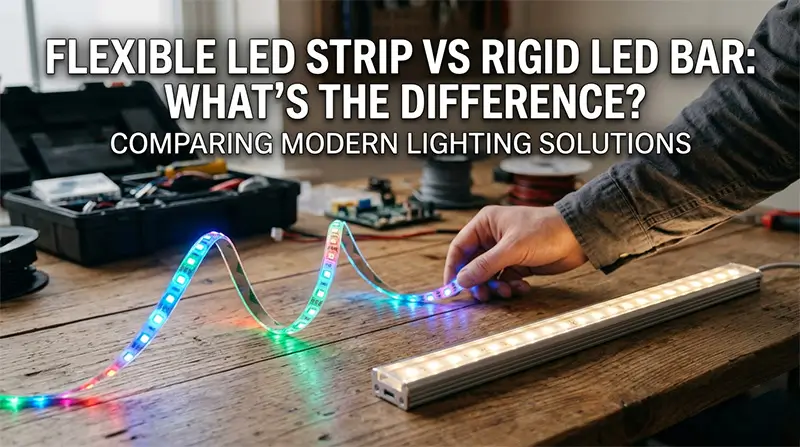
The difference between flexible LED strips and rigid LED bars is not about which one is better, but about what kind of lighting requirement they are designed to solve.
Flexible LED strips are built for adaptability, visual aesthetics, and concealed installation. Rigid LED bars, on the other hand, are engineered for structural stability, efficient heat dissipation, and high-output performance.
In real-world projects, these two products are rarely interchangeable. Instead, they are often used together to achieve both design flexibility and functional lighting performance.
The fundamental difference starts with the circuit structure.
Flexible LED strip lights use FPC (Flexible Printed Circuit), allowing them to bend and conform to curved or irregular surfaces. This makes them ideal for architectural contours, recessed profiles, and indirect lighting applications.
Rigid LED bars are typically built on aluminum PCBs or metal-backed boards. This rigid structure cannot bend, but it provides excellent mechanical stability and significantly better thermal management.
Thermal performance is one of the most critical factors in LED lifespan. Rigid LED bars dissipate heat more efficiently due to the aluminum base, which reduces junction temperature and slows down lumen depreciation over time. Flexible strips rely more on the mounting surface and ambient conditions for heat dissipation, which makes proper installation more important in higher power applications.
In terms of light output, flexible strips—especially COB LED strip lights—offer a continuous, dot-free illumination that enhances visual comfort and premium aesthetics. Rigid LED bars typically deliver more concentrated and higher-intensity light, making them suitable for task-oriented lighting.
When it comes to environmental resistance, flexible LED strips can be encapsulated with silicone to achieve waterproof ratings such as IP67 or IP68. This makes them highly suitable for outdoor or wet environments. Rigid LED bars usually require additional housings for protection and are more commonly used in controlled indoor environments.
| Feature | Flexible LED Strip | Rigid LED Bar |
|---|---|---|
| Structure | Flexible FPC | Aluminum or rigid PCB |
| Flexibility | Bendable, shapeable | Fixed, straight |
| Heat Dissipation | Moderate | Excellent |
| Light Effect | Soft, continuous (COB) | Bright, focused |
| Installation | Flexible, concealed | Fixed mounting |
| Waterproof Capability | Up to IP67/IP68 | Limited (depends on housing) |
| Typical Use | Decorative & contour lighting | Functional & task lighting |
A quick way to decide: flexible strips are ideal for design-driven lighting, while rigid bars are better suited for performance-driven applications.
In professional lighting design, different areas within the same project often require completely different lighting characteristics.
For example, in commercial interiors, indirect lighting in ceilings or walls is typically achieved using COB flexible LED strips to create a seamless and high-end visual effect. Meanwhile, display areas or workspaces require higher illumination levels, where rigid LED bars provide better performance.
In architectural façade lighting, flexible silicone LED strips are commonly used to define building outlines due to their ability to follow curves and withstand outdoor conditions. At the same time, rigid LED bars may be used in specific zones that demand higher brightness or more focused lighting.
This combination approach allows designers and engineers to balance aesthetics, performance, and long-term reliability.
For interior ambient lighting in hotels, residential projects, or retail spaces, flexible LED strips are typically the preferred solution. COB LED strips or silicone LED strips can deliver uniform, dot-free lighting while remaining hidden within architectural elements.
In outdoor environments such as building façades, landscape lighting, or bridges, waterproof silicone LED strips are the safer and more adaptable choice. Their integrated sealing structure ensures long-term durability under harsh conditions.
For cabinet lighting, shelving, and linear illumination, rigid LED bars offer better precision, stability, and consistent brightness, especially in applications where alignment and uniformity are critical.
In industrial or high-duty-cycle environments, rigid LED bars are generally the more reliable option. Their superior heat dissipation allows them to operate at higher power levels over extended periods without significant degradation.
One of the most frequent concerns is durability. Rigid LED bars tend to perform better in high-load applications due to their thermal advantages. However, high-quality silicone LED strips can also achieve long lifespans when properly installed.
Another common question is whether flexible LED strips are fragile. In practice, durability depends more on material quality, driver stability, and installation conditions than on whether the product is flexible or rigid.
For outdoor use, waterproof ratings are critical. Silicone-encapsulated LED strips with IP67 or IP68 ratings provide significantly better protection against moisture and environmental exposure.
Regarding brightness, rigid LED bars often support higher wattage due to better heat management, which results in higher luminous output.
It is also important to understand that these two product types are not substitutes. Flexible strips are primarily used for visual lines and atmosphere, while rigid bars are used for illumination and performance.
In real projects, choosing a single product type is rarely sufficient. A more effective approach is to define lighting requirements by area and function, then match the appropriate product accordingly.
At ZBL Lighting, this approach is applied across a wide range of projects. Flexible LED strips are used to create architectural outlines and ambient lighting, while rigid LED bars are integrated where higher brightness and structural stability are required.
This combination strategy allows for better control over lighting quality, installation efficiency, and long-term maintenance costs. In addition, customization in dimensions, structure, and optical performance ensures that each solution fits the specific project requirements.
For B2B clients, this shift from “product selection” to “solution design” is what ultimately improves project outcomes and client satisfaction.
Flexible LED strips are ideal for complex shapes and ambient lighting, offering design freedom and visual refinement.
Rigid LED bars are better suited for high-brightness and functional lighting, delivering stability and long-term performance.
For outdoor applications, waterproof silicone LED strips provide superior environmental resistance.
For industrial or continuous-use scenarios, rigid LED bars offer greater reliability.
In most professional projects, the optimal solution is a combination of both, rather than choosing one over the other.
Need professional help? Contact our team for expert support and personalized solutions. We’re here to assist you. Contact Us



Mobile:+86 18923408595
Email:info@zbl-lighting.com
Zip Code: 518106
Xin Wei Forth industrical Zone,Gong Ming Town,Guangming New Area,Shen Zhen,Guangdong,China