High Quality OEM/ODM LED Strip Manufacturer

High Quality OEM/ODM LED Strip Manufacturer
Published: July 13, 2023 Updated: July 13, 2023 795
Quick answer: Choose a 12V LED strip when you need short cutting intervals, compact battery compatibility, or short runs such as vehicle, display, and cabinet sections. Choose a 24V LED strip for most architectural, commercial, and longer linear installations because it carries half the current at the same wattage and normally experiences less visible voltage drop. Voltage alone does not determine brightness; LED density, power per meter, chip efficiency, PCB design, and thermal management matter more.
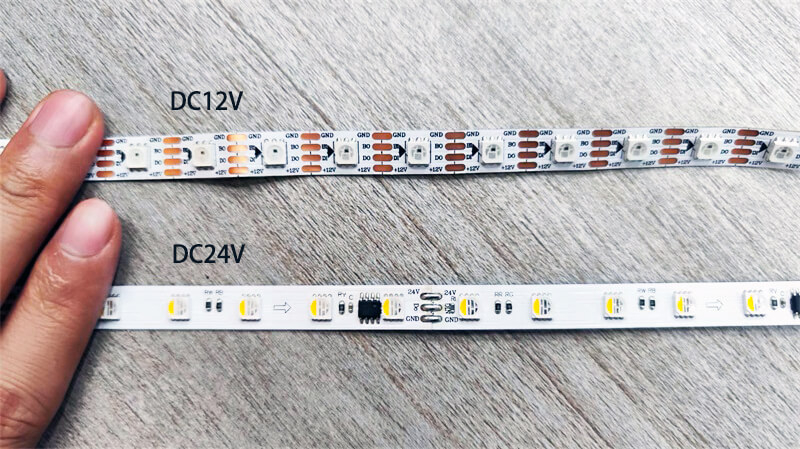
| Factor | 12V LED strip | 24V LED strip |
|---|---|---|
| Best use | Short sections, vehicles, battery systems, detailed shapes | Longer runs, architectural lines, commercial installations |
| Current at equal power | Higher | Approximately half the 12V current |
| Voltage drop | More noticeable over the same cable and run length | Usually easier to control over longer runs |
| Typical cutting interval | Usually shorter | Usually longer |
| Power injection | Generally needed sooner | Generally allows longer practical runs |
| Controller requirement | Must support 12V and the required current | Must support 24V and the required current |
| Brightness and efficacy | Depends on the strip design | Depends on the strip design |
For a given load, electrical power is calculated as P = V × I. A 60W installation draws approximately 5A at 12V but only 2.5A at 24V. Lower current reduces resistive loss in cables and copper tracks, which is why 24V systems are normally easier to design for long continuous lines.
This does not mean every 24V strip is more efficient or brighter than every 12V strip. Two strips must be compared at the same power, LED density, color temperature, CRI, waterproof construction, and operating temperature. A well-designed 12V strip can outperform a poor 24V strip.
Every cable and flexible PCB has electrical resistance. As current travels along the strip, part of the supply voltage is lost. Excessive voltage drop can cause the far end to appear dimmer or, on RGB products, produce color shift because the red, green, and blue channels do not respond identically.
The basic relationship is voltage drop = current × resistance. Since a 24V system uses less current for the same power, it usually loses a smaller percentage of its supply voltage over an equivalent installation.
Do not use a universal rule such as “12V always runs 5 meters” or “24V always runs 10 meters.” The real maximum depends on watts per meter, PCB copper weight, trace width, LED density, cable size, waterproof coating, and whether power is supplied from one end, both ends, or multiple points.
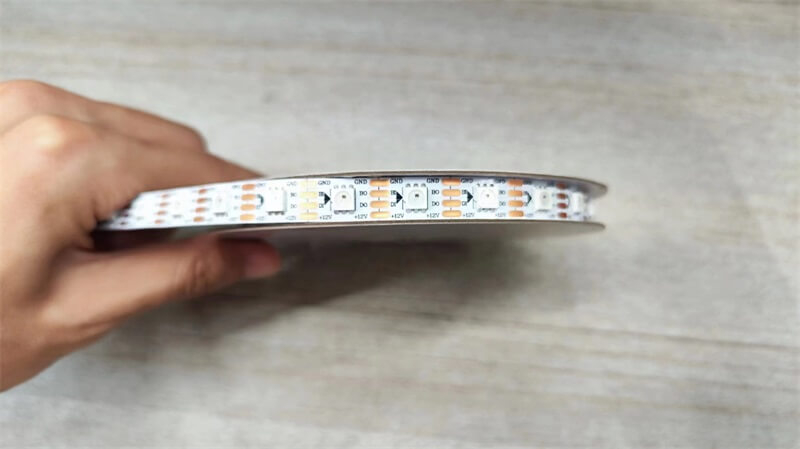
Voltage affects how LEDs are grouped on a constant-voltage strip. A 12V strip often uses groups of three LEDs, while a 24V strip commonly uses larger groups. The exact design varies with LED type and circuit architecture, particularly for COB, addressable, and constant-current products.
Always check the marked cutting points on the actual product. Never assume that two products with the same voltage have the same cutting interval. If precise custom lengths matter, review our freely cuttable COB LED strip or request a purpose-built configuration.
Calculate total strip power before selecting the driver:
Total power = watts per meter × installed length.
Then add suitable design headroom. For example, 8 meters of 10W/m strip consumes 80W. A power supply should not be continuously operated at its absolute maximum rating; its capacity, installation temperature, enclosure, applicable electrical standard, and manufacturer guidance must all be considered.
The power supply voltage must match the strip voltage. Never connect a 12V strip directly to a 24V supply. A 24V strip on a 12V supply will normally be under-driven or fail to operate correctly.
Every component in the circuit must support the selected voltage and current: power supply, dimmer, RGB controller, amplifier, connector, cable, and protection device. A controller marked for both 12V and 24V may support different maximum wattages at each voltage, so check its per-channel current rating rather than relying only on the headline wattage.
For dynamic professional installations, our DMX512 LED strip solution explains control topology, addressing, and project configuration.
Both 12V and 24V systems are commonly used as low-voltage lighting systems. Safety depends on the complete installation, including the approved power supply, insulation, grounding where required, cable protection, moisture protection, ventilation, and compliance with local electrical regulations. Do not treat low voltage as permission to ignore current, heat, short-circuit, or fire risks.
Not automatically. Brightness is determined by the product design and operating power. Voltage mainly changes circuit grouping, current, voltage-drop behavior, and component compatibility.
No. Applying 24V directly to a standard 12V strip can overdrive and permanently damage it. Use a matching 12V supply or a properly specified voltage converter.
Only if the controller explicitly supports both voltages and its channel current rating is sufficient. The strip and power supply must always operate at the same voltage.
No. It reduces the percentage impact under comparable conditions, but long or high-power runs may still require larger cables, two-end feeding, or additional power-injection points.
Either voltage may work. Check the strip wattage, manufacturer maximum run, PCB construction, required brightness consistency, and power-feed arrangement. For higher-power or professional installations, 24V is often easier to engineer.
For most fixed architectural and commercial projects, 24V is the practical default. For short sections, vehicle systems, portable lighting, or designs requiring tighter cut increments, 12V may be the better fit. Compare our SMD LED strip options, or contact ZBL Lighting for a custom voltage and power configuration based on your run length and installation environment.
Need professional help? Contact our team for expert support and personalized solutions. We’re here to assist you. Contact Us



Mobile:+86 18923408595
Email:info@zbl-lighting.com
Zip Code: 518106
Xin Wei Forth industrical Zone,Gong Ming Town,Guangming New Area,Shen Zhen,Guangdong,China